
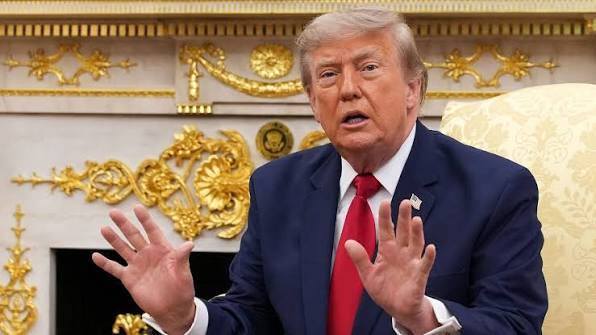
US President Donald Trump has issued a warning that Washington will target Iranian infrastructure, including bridges and power plants, whenever Tehran attacks ships passing through the strategically important Strait of Hormuz. The statement comes as tensions between the two countries intensify, with the conflict entering its fifth month and raising concerns about global energy security.
Trump said in a social media statement on Wednesday that every attack on commercial or military vessels in the Strait of Hormuz would trigger a US response against Iranian civilian infrastructure.
“Any time the Islamic Republic of Iran shoots at a ship in the Strait of Hormuz, whether it be by Missile, Rocket, Drone, or any other device or weapon, the United States will bomb and destroy ONE BRIDGE OR POWER PLANT,” Trump wrote.
The warning followed a US military strike on Iran’s Larak Island, located in the Strait of Hormuz, a key maritime route responsible for a significant portion of the world’s oil shipments. Iranian state-linked media reported that a US missile hit the island, while officials said assessments were underway to determine the extent of the damage.
The Pentagon has continued carrying out air and missile operations against Iranian targets, claiming the strikes are aimed at reducing Tehran’s ability to threaten commercial shipping in the region.
US Defense Secretary Pete Hegseth recently revealed that the ongoing military campaign has already cost Washington around $37.5 billion. The rising financial burden has increased pressure on the Trump administration, especially as the November legislative elections approach.
Despite criticism, Trump has insisted that the United States will not end the operation immediately.
“We’re not finished at all,” Trump said, adding that American forces would remain engaged.
US Open to Diplomacy Despite Military Escalation
While military operations continue, Secretary of State Marco Rubio said the United States remains willing to negotiate with Iran if Tehran shows seriousness toward reaching an agreement.
“We remain open to working it out in a negotiated way. But right now, they don’t seem to be serious about that,” Rubio said during a Southeast Asia ministers’ meeting in Manila.
Iranian officials have also said diplomatic communication through intermediaries is still ongoing. However, both sides continue to exchange threats, creating uncertainty over whether negotiations can prevent further escalation.
The conflict has also raised concerns over Iran’s nuclear activities. Trump previously suggested that a possible future target could be Pickaxe Mountain, also known as Kolang Mountain, an underground facility near Natanz that Western intelligence agencies suspect may be linked to Iran’s nuclear enrichment efforts.
Iran has strongly rejected those allegations, calling the accusations a justification for further attacks. Iranian officials warned that any strike on the underground site would be considered an expansion of the war and could trigger retaliation against US interests and allies across the region.
Regional Attacks Increase as Gulf States Face Threats
The growing conflict has spread beyond Iran and the United States, with several Gulf countries reporting missile and drone activity.
Kuwait said its air defense systems engaged Iranian drones, while Jordan announced that it intercepted multiple missiles and drones. Air raid sirens were also reported in Bahrain following explosions heard in the capital city of Manama.
Iran’s military claimed it had targeted US-linked facilities in Kuwait, Bahrain, and Jordan, including radar systems, air defense locations, and administrative buildings.
Meanwhile, concerns are increasing over the impact on global oil markets. Brent crude prices jumped more than 4% and moved above $95 per barrel as fears grew that shipping disruptions could affect energy supplies.
The situation has also drawn attention to Yemen’s Houthi movement, which has threatened possible action against Saudi ports. Trump warned that the United States would respond if the group attempted to block maritime routes.
Any disruption to Saudi oil exports could have major consequences for the global economy, especially if it affects alternative routes used to avoid the Strait of Hormuz.
The latest escalation follows months of regional instability linked to attacks on shipping routes in the Red Sea and Gulf of Aden. Previous Houthi attacks forced many international vessels to reroute around Africa, increasing transportation costs and putting additional pressure on global trade.