






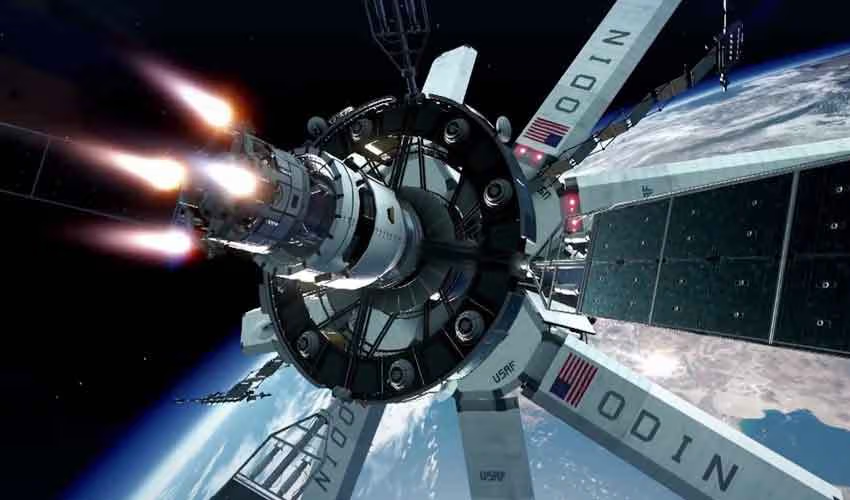
The United States has publicly confirmed for the first time that it has weapons operating in orbit, marking a significant development in the growing military competition over space.
US Secretary of the Air Force Troy Meink made the disclosure Monday while speaking at the Air, Space and Cyber Conference in Maryland.
Meink said the United States now possesses “on-orbit space control weapons” designed to protect American forces from hostile actions by adversaries.
The announcement was deliberate, but Meink provided few details about the systems, including when they were deployed, what they can do or whether they have undergone testing.
Pentagon Keeps Capabilities Classified
Meink said Washington would not disclose specific information about the newly acknowledged weapons.
He argued that revealing too much about their capabilities could undermine their purpose as a deterrent.
The Air Force secretary said the United States must be prepared to respond if American space assets are threatened and maintain the ability to operate freely in orbit.
Space has become increasingly important to the US military because satellites support communications, navigation, intelligence gathering, surveillance and targeting.
Meink emphasized that maintaining military strength in space is now as important as maintaining US capabilities in the air.
What Does ‘Space Control’ Mean?
The US Space Force uses the term “space control” to describe operations intended to establish or maintain control of the space environment.
Those operations can include both defensive and offensive capabilities.
According to the Space Force, such systems can disrupt, degrade or potentially destroy an adversary’s space assets. Some capabilities operate in orbit, while others can be deployed from the ground.
Potential space-control technologies include satellite communications jamming, cyber operations, attacks against satellite ground infrastructure and systems capable of interfering with or physically damaging spacecraft.
The US government has not confirmed which of these capabilities are represented by Meink’s announcement.
Russia and China Drive US Space Concerns
American officials have increasingly identified China and Russia as major threats to US space infrastructure.
Military planners have warned that both countries are developing counter-space technologies capable of disrupting satellites and other systems that support military operations.
US assessments have described China as developing and operating space and counter-space capabilities as part of its broader military modernization effort.
Russia, meanwhile, has treated space as an increasingly important component of modern warfare.
Space Force Chief of Space Operations General Chance Saltzman warned earlier this year that China’s rapid development of space-based capabilities represented a substantial threat.
The United States has also raised concerns about Russian satellite activity and the development of systems potentially capable of targeting spacecraft.
Russian Satellites Raise Additional Concerns
US concerns extend beyond traditional anti-satellite weapons.
Reports earlier this year indicated that Russian satellites may have intercepted communications involving European satellites since Moscow launched its full-scale invasion of Ukraine.
Such activities could potentially provide intelligence opportunities or create vulnerabilities in satellite networks.
Washington also said in 2024 that Russia had placed a satellite in orbit that the United States believed could potentially attack other spacecraft.
Moscow has not publicly accepted the US characterization.
These developments have contributed to growing concerns that Earth’s orbit could become a contested military environment.
Golden Dome Adds to US Space Ambitions
Meink’s disclosure also comes as the Trump administration advances its ambitious Golden Dome missile-defense initiative.
The proposed system is expected to rely partly on space-based technologies to detect and counter incoming missile threats.
Meink said the program has progressed beyond its initial contracting stage and now involves what he described as flight-ready hardware for space-based interceptors.
The Space-Based Interceptor program is expected to become an important component of the broader Golden Dome architecture.
Meink also mentioned a planned Space-Based Air-Moving Target Indication constellation, although he did not provide detailed information about either system.
What Kind of Weapon Is in Orbit?
The biggest unanswered question is what the newly acknowledged US orbital weapon actually is.
Possible technologies range from satellite-based jammers and cyber systems to lasers and spacecraft capable of maneuvering close to another satellite.
Kinetic anti-satellite weapons can physically destroy spacecraft, but such attacks can create large amounts of orbital debris.
That risk has made some experts skeptical that the system acknowledged by Meink is necessarily a conventional destructive weapon.
Space security analysts have suggested that a jammer or another non-kinetic capability could be involved.
However, without additional information from the Pentagon or Space Force, the exact nature of the weapon remains unknown.
Experts Warn of a New Space Arms Race
The announcement has also raised concerns about how Russia and China could respond.
Some experts argue that a public acknowledgment of US orbital weapons could encourage rival governments to expand their own counter-space programs.
A more aggressive competition could eventually create a cycle in which each major power develops increasingly sophisticated systems to attack or defend satellites.
Experts have also warned that ambiguity can create risks of miscalculation.
If countries do not understand the capabilities or intentions of an adversary’s space systems, an incident involving a satellite could potentially escalate into a wider military confrontation.
Space Conflict Could Create Orbital Debris
Any major conflict in orbit could have consequences beyond military satellites.
A kinetic attack that destroys a spacecraft can generate thousands of high-speed fragments. Those pieces can remain in orbit and threaten other satellites for years or even decades.
The problem is becoming more important as the number of spacecraft around Earth continues to increase.
SpaceX alone operates thousands of Starlink satellites, with additional launches planned.
A large-scale conflict in orbit could therefore threaten commercial spacecraft as well as military systems, potentially affecting communications, navigation and other services used by civilians around the world.
US Space Force Prepares for a New Battlefield
The US Space Force was created in 2019 as America’s newest military branch and was tasked with protecting US interests and assets in space.
The service operates and supports hundreds of satellites that provide critical communications, surveillance and other capabilities.
Under the Trump administration, the Space Force’s role has increasingly included preparing for offensive as well as defensive space operations.
US officials argue that these capabilities are necessary because Russia and China have developed technologies capable of threatening American satellites.
The Space Force has described its mission as ensuring the United States can contest and control the space domain when required.
International Rules Leave Room for Conventional Weapons
International law places restrictions on certain military activities in space, but it does not ban every form of space-based weapon.
The 1967 Outer Space Treaty prohibits placing weapons of mass destruction in orbit and establishes broader principles governing the peaceful use of outer space.
Conventional weapons and anti-satellite systems, however, are not comprehensively prohibited by the treaty.
That legal gap has allowed major military powers to develop counter-space technologies while diplomatic efforts continue over how future space warfare should be regulated.
Washington Frames Disclosure as Deterrence
Meink said the decision to acknowledge the weapons was intended to send a message to potential adversaries without revealing sensitive information.
The Space Force has similarly argued that greater transparency about US space operations can strengthen deterrence and reduce the possibility of an opponent miscalculating Washington’s capabilities.
Still, the announcement represents a notable change in the public conversation surrounding US space warfare.
For years, American officials have warned about threats to satellites and discussed the need for counter-space capabilities. Meink’s statement now confirms that at least some US weapons designed for space control are already operating in orbit.
The exact systems, deployment dates and operational capabilities remain classified.