
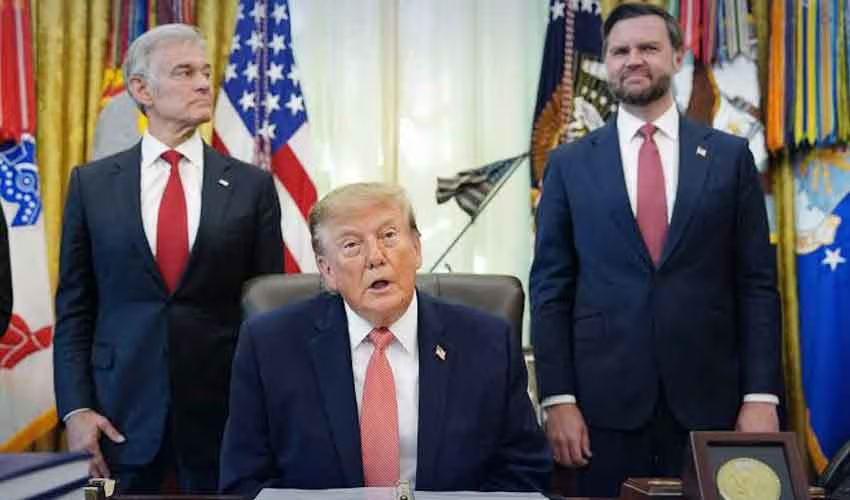
US President Donald Trump has expressed confidence that the conflict with Iran will end soon, rejecting the possibility that the war could continue beyond the upcoming US midterm elections. He said Washington was making progress and would decide whether to pursue a favorable diplomatic resolution or adopt a tougher approach toward Tehran.
Speaking to reporters at the White House and addressing an election rally, Trump reiterated that preventing Iran from developing nuclear weapons remains his administration’s primary objective. He also predicted that global oil prices would fall sharply once the conflict ends.
Trump claimed that Iran wanted the war to continue beyond the US midterm elections but insisted that his administration would not allow that scenario to unfold. He maintained that the United States remained in a strong position and did not require assistance from other countries to address the situation.
“Everything is going very well regarding Iran,” Trump said, expressing confidence in the progress of the US campaign. However, he acknowledged that a major decision remained about how Washington would pursue the next stage of the conflict.
The president indicated that the United States could seek an outcome favorable to its interests through negotiations or take a more forceful course if necessary. His remarks underscored the administration’s continued focus on Iran’s nuclear capabilities and the broader security implications of the conflict.
Trump Predicts Oil Prices Will Drop After Iran Conflict
Trump also suggested that international energy markets could experience significant relief when the war with Iran comes to an end. According to the president, oil prices would decline sharply after hostilities cease.
The conflict has raised concerns about global energy supplies, market stability and the potential effects of geopolitical tensions on fuel costs. Uncertainty surrounding the situation has made developments involving Iran particularly important for oil-importing countries and consumers monitoring gasoline prices.
Trump expressed confidence that an end to the fighting would improve the outlook for energy markets. However, the timing and extent of any price decline will depend on developments in the conflict, oil production, transportation conditions and broader market demand.
The president also maintained that the United States had achieved substantial success in its campaign against Iran. He suggested that Tehran could withdraw from the conflict immediately without changing his assessment of the overall outcome.
Preventing Iran From Acquiring Nuclear Weapons Remains Trump’s Priority
A central theme of Trump’s remarks was his determination to prevent Iran from obtaining nuclear weapons. He described Iran as the world’s leading state sponsor of terrorism and argued that the cost of the military campaign was small compared with the potential consequences of allowing Tehran to develop such weapons.
Trump also discussed Iran’s nuclear facilities, claiming that they were situated deep beneath rock formations and that attacks had left the targeted sites in ruins. These statements represented the president’s assessment of the impact of the strikes.
He emphasized that the US objective extended beyond the immediate fighting. Trump said Iran must remain unable to develop nuclear weapons not only in the near future but also over the next five, six or even ten years.
His comments suggest that Washington’s approach is focused on limiting Iran’s long-term nuclear capabilities rather than simply bringing the current conflict to a close.
The administration’s position also highlights the relationship between military objectives, regional security and the possibility of a negotiated settlement. Whether the conflict ends through diplomacy or further military action remains a major question for the countries involved.
Trump Pressures Zelenskyy to Reach Ukraine Peace Agreement
During the same remarks, Trump turned his attention to the war between Russia and Ukraine, urging Ukrainian President Volodymyr Zelenskyy to agree to a peace settlement.
The US president warned that failing to reach an agreement could have serious consequences for Ukraine. He said Washington wanted the conflict to end soon and argued that Kyiv needed to be prepared to negotiate.
“We have given a great deal to Ukraine, but received nothing in return,” Trump said, renewing his criticism of US assistance to the country.
Trump has repeatedly questioned the scale of American support for Ukraine and emphasized the need for a negotiated end to the fighting. His latest comments reflected continued pressure on Zelenskyy as Washington seeks progress toward a settlement.
The president warned that the situation could become “very bad” if the Ukrainian leader failed to reach an agreement. He did not provide specific details about the terms he expected Ukraine to accept.
Trump Says Russia Wants to End Ukraine War
Trump also claimed that Russia wanted to end its war with Ukraine following recent discussions about the conflict. He offered limited details about the conversations but indicated that diplomatic efforts were continuing.
The president said his envoy, Steve Witkoff, was scheduled to travel to Russia the following day as part of the ongoing diplomatic engagement.
The planned visit, as described by Trump, came amid efforts to explore a possible agreement between Moscow and Kyiv. However, the prospects for a settlement depend on the positions of both countries and their willingness to resolve outstanding disagreements.
Trump’s remarks indicated that his administration was seeking movement on two major international conflicts while emphasizing negotiation as a potential path forward. His approach toward Iran, however, continues to leave open the possibility of a tougher response if Washington does not secure an acceptable outcome.
The president also criticized the situation in France, describing conditions there as very bad. He referred to immigration policy and said he had previously advised France against allowing immigrants to enter the country, adding another domestic and international political issue to his wide-ranging remarks.