
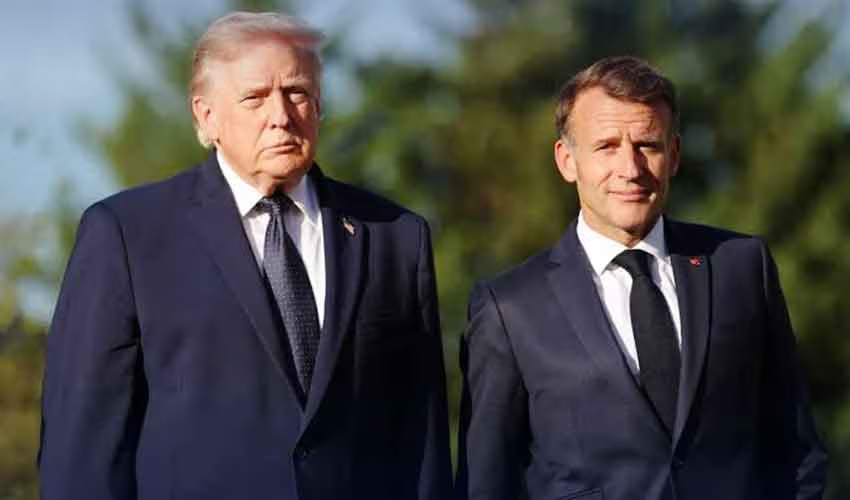
French President Emmanuel Macron has strongly criticized US President Donald Trump and other foreign leaders for spreading what he described as misleading claims about violent protests in France. Macron accused political figures of exploiting the country’s unrest for electoral advantage, rejecting allegations that Muslim migrants and Islamists were responsible for the violence.
Speaking in Qatar on October 21, Macron addressed claims circulating internationally following a weekend of rioting, looting and clashes in Paris and other French cities. He said foreign manipulation of information had contributed to the controversy and condemned comments from several international figures as unacceptable and foolish.
When asked whether his criticism included Trump, Macron responded, “Among others.”
The dispute has added another source of tension between the two leaders, whose relationship has become increasingly strained as Trump has publicly criticized his French counterpart.
Macron Rejects Trump’s Claims About Muslim Migrants
Trump has used the unrest in France to criticize the country’s immigration policies, making claims that Muslim migrants were responsible for the violence. He has urged Macron to tighten border controls and take stronger action against people involved in the demonstrations.
The US president reportedly warned that Paris could become a Muslim-majority city and argued that Europe faced serious consequences if governments failed to restrict immigration and address criminal activity.
Macron rejected those claims, insisting that France had not been overwhelmed by migrants or Islamists.
“We’ve had people claiming that we were invaded by hordes of migrants and Islamists, which is completely false,” the French president said.
His response highlighted growing concerns about how political disputes over immigration, religion and public security can influence international perceptions of domestic unrest.
The French government has condemned the violence while maintaining that criminal activity during demonstrations should not be used to portray entire communities as responsible.
Macron also suggested that some foreign politicians were repeating allegations without adequately examining the available evidence, allowing misleading narratives to spread beyond France.
Macron Warns About AI-Generated Images and Online Misinformation
The French president also raised concerns about artificial intelligence-generated images circulating online in connection with the protests.
According to Macron, some images portrayed events that had not actually taken place in France. He warned that political figures could unintentionally or deliberately amplify misleading material, making it harder for the public to distinguish genuine events from fabricated content.
He argued that leaders involved in election campaigns were using France’s difficult situation to advance their own political interests.
Macron did not identify the specific AI-generated images he was discussing during his remarks. Nevertheless, his comments drew attention to the growing role of manipulated digital content in political debates and breaking news coverage.
French Foreign Minister Jean-Noël Barrot said his office could provide clarifications to the countries concerned to help prevent officials from repeating false information or making unsupported claims on social media.
The controversy comes as political leaders increasingly face questions about misinformation, online propaganda and the use of viral content to influence public opinion.
France Protests Escalate Over Rising Living Costs
The political dispute has unfolded alongside widespread demonstrations over the rising cost of living in France. Higher fuel, energy and food prices have increased pressure on households, workers and students already concerned about economic conditions.
According to the supplied reports, more than 500,000 people demonstrated across France on October 17. The protests initially included students calling for increased education funding before attracting trade unions, farmers and other groups demanding action on affordability.
Some demonstrations subsequently turned violent, with clashes and looting reported in Paris and other cities. Authorities have faced pressure to restore public order while responding to the economic grievances that helped bring people onto the streets.
Student groups have raised concerns about underfunded schools, deteriorating facilities and staff shortages, particularly in lower-income communities. Other complaints include demanding school schedules and concerns about the university admissions process.
Macron has acknowledged that the protests reflect problems extending beyond fuel prices. He has also warned against allowing the violence to become a justification for spreading unsubstantiated claims about migrants and religious communities.
France Seeks More Diesel Supplies to Address Energy Crisis
Alongside the domestic unrest, Macron has been working to strengthen France’s energy supplies as rising fuel costs add to public frustration.
During a tour of Gulf energy suppliers, the French president sought additional deliveries of oil, gas, diesel and jet fuel. France secured an additional 100,000 metric tonnes of diesel per month from the United Arab Emirates, while a further 100,000 tonnes from Bahrain remained subject to confirmation.
The Élysée Palace said potential additional diesel supplies, including deliveries from Saudi Arabia, could reach nearly 295,000 metric tonnes per month. That amount would represent more than 10% of France’s monthly diesel consumption.
Macron subsequently travelled to Saudi Arabia for talks with Crown Prince Mohammed bin Salman as part of efforts to diversify French energy supplies and limit the effects of rising prices.
The president has also backed international action to stabilize energy markets. Earlier in October, the Group of Seven advanced plans to release 100 million barrels of oil and fuel products from strategic reserves.
Macron said France had initiated the G7 meeting that led to the agreement and expected its implementation to help bring prices down from early November.
However, additional supplies and strategic reserve releases may not immediately resolve the broader cost-of-living crisis. Fuel prices, household expenses and concerns about public services remain significant sources of frustration for demonstrators.
Paris Bans Protest as Authorities Prepare for More Unrest
French authorities are preparing for further demonstrations following calls from student unions and groups associated with the Yellow Vest movement, which organized major protests over fuel prices in 2018 and 2019.
Paris police announced a ban on a planned demonstration for Thursday, citing public safety and the need to protect property. Prime Minister Sébastien Lecornu also said a large security operation was being prepared for Saturday.
The measures aim to prevent another outbreak of violence after small groups of rioters caused damage during the previous demonstrations.
Authorities have imposed curfews in selected areas of several major cities, including parts of Paris. Although France experienced two consecutive quiet nights following the weekend’s unrest, officials remain concerned about the possibility of renewed clashes.
Macron now faces the challenge of containing the political fallout from the protests while addressing public concerns about living costs, energy prices and education.
His criticism of Trump has added an international dimension to the crisis, turning France’s domestic unrest into a broader debate over immigration, political rhetoric and the spread of misinformation ahead of the US midterm elections.