
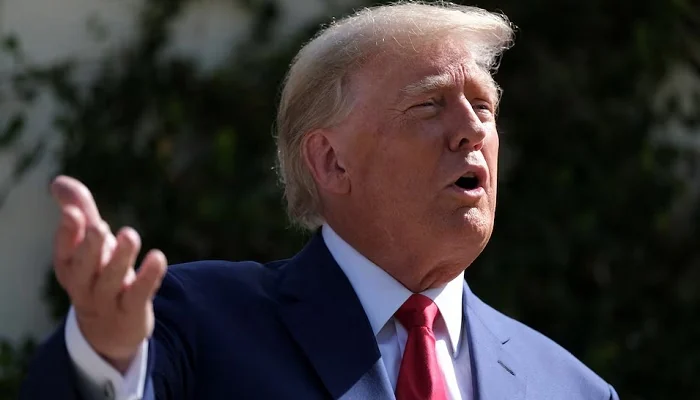
US President Donald Trump’s approval rating remains close to its lowest level since returning to the White House, as rising fuel prices, economic concerns and opposition to the Iran war contribute to growing public dissatisfaction, according to a new Reuters/Ipsos poll.
The survey found that only 32% of Americans approve of Trump’s performance as president, highlighting the political challenges facing his administration amid an increasingly unpopular conflict with Iran.
Public support for the war is even weaker, with just 31% of respondents saying they support US military involvement in the conflict.
The four-day Reuters/Ipsos survey, completed on Monday, showed little improvement in Trump’s approval rating over recent weeks. His rating has remained broadly unchanged across four consecutive polls since mid-October.
In October, Trump’s approval stood at 31%, marking the lowest level recorded during his presidency.
The findings suggest that the economic consequences of the Iran conflict are becoming a significant concern for American voters, particularly as higher fuel prices place additional pressure on household budgets.
Iran War and Rising Fuel Prices Put Pressure on Trump
The conflict with Iran has emerged as a major political challenge for the Trump administration, with its economic impact extending beyond the Middle East.
Higher energy prices have contributed to growing financial pressure on American households, making the cost of living an increasingly important issue for voters.
The latest poll indicates that only about three in 10 Americans support the US war with Iran, reflecting widespread reservations about the military campaign.
Trump’s declining popularity has also become a concern for Republicans following their poor performance in the November 3 midterm elections.
Democrats are expected to take control of both chambers of Congress in January, creating additional political obstacles for the president as he attempts to advance his domestic and foreign policy priorities.
The combination of unpopular military involvement and rising living costs has placed the administration under greater scrutiny, particularly among Americans concerned about the financial consequences of the conflict.
Chuck Schumer Faces Growing Dissatisfaction Within Democratic Party
The Reuters/Ipsos survey also revealed challenges for Democratic Senate leader Chuck Schumer, who is facing criticism from members of his own party.
Among self-identified Democrats, 43% said they viewed Schumer unfavourably, while 34% expressed a favourable opinion of him.
Another 22% said they had never heard of the Senate Minority Leader.
The figures represent a noticeable change from a February Reuters/Ipsos survey, when 38% of Democrats viewed Schumer favourably and 37% had an unfavourable opinion.
Schumer is facing a potential leadership challenge from fellow Democratic Senator Chris Van Hollen of Maryland as dissatisfaction grows over the party’s direction and its approach to major political issues.
Israel Policy Creates Divisions Among Democrats
Differences over US support for Israel have become another source of disagreement within the Democratic Party.
Van Hollen has taken a more critical position regarding Israel’s military campaign in Gaza and has argued that restricting certain weapons sales to Israel could be necessary.
Schumer has also criticized Israeli military operations in Gaza but has voted against proposals seeking to restrict arms sales to the US ally.
These contrasting positions reflect wider disagreements among Democrats over Washington’s relationship with Israel and its response to the humanitarian situation in Gaza.
Israel’s military campaign following the October 2023 attacks by Palestinian militants has contributed to changing attitudes toward the country among some Democratic voters.
The issue has created political challenges for party leaders as they attempt to balance longstanding US support for Israel with growing criticism from parts of their voter base.
Hakeem Jeffries Receives Better Ratings Than Schumer
The poll also examined Democratic opinions of House Minority Leader Hakeem Jeffries.
His ratings were comparatively more favourable among Democratic respondents, with 40% expressing a positive opinion and 29% viewing him unfavourably.
Another 29% said they did not know who he was.
The findings suggest that Schumer is facing a more difficult image problem within his party as questions about Democratic leadership and political strategy continue.
Meanwhile, Republican voters remain largely supportive of their party’s leading figures.
According to the survey, 75% of Republicans viewed Trump favourably, while 77% expressed a favourable opinion of Vice President JD Vance.
The figures highlight a contrast between dissatisfaction among some Democratic voters over their Senate leadership and continued support for Trump and Vance among Republican respondents.
What the Reuters/Ipsos Poll Reveals About US Politics
The Reuters/Ipsos survey was conducted online among 1,521 adults across the United States over four days and was completed on Monday.
It carries a margin of error of approximately three percentage points.
The results provide a snapshot of American public opinion as the country deals with economic uncertainty, rising energy costs and continuing debate over the Iran conflict.
For Trump, the combination of low approval ratings and limited public support for the war presents a difficult political environment.
For Democrats, the findings highlight a separate challenge involving leadership approval and internal disagreements over foreign policy, particularly regarding Israel.
As the new Congress prepares to take office in January, both parties face questions about how they will respond to voters’ concerns over the economy, international conflicts and political leadership.