
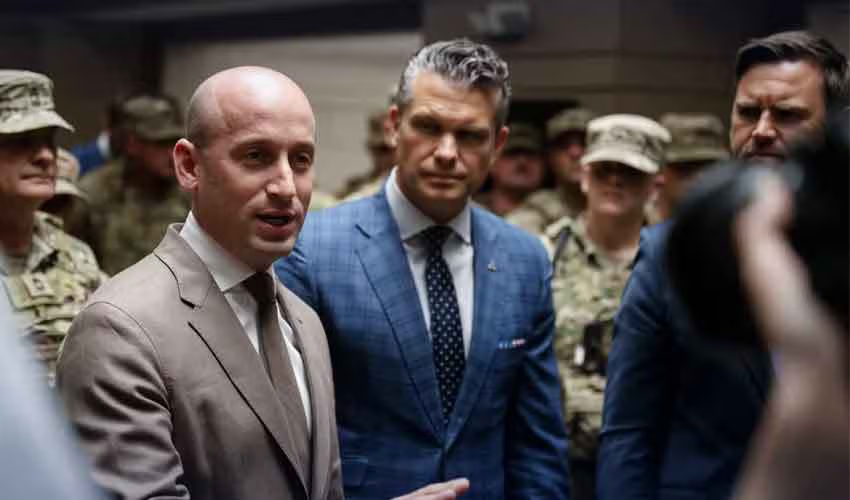
Several senior members of President Donald Trump’s administration are relocating to secure military residences in Washington, DC, amid concerns over political violence, foreign threats and targeted harassment. The trend has raised questions about security arrangements, housing costs and the growing separation between government officials and ordinary Americans.
A growing number of senior officials in the Trump administration are choosing to live inside heavily guarded military installations rather than private homes in Washington, DC. The relocations reflect increasing concerns about personal safety as government officials face threats linked to domestic political tensions and foreign adversaries.
Reports indicate that approximately half a dozen Cabinet members and senior administration officials are now living in military housing traditionally reserved for generals and high-ranking military personnel.
These historic residences, many of which are more than 100 years old, are located within military compounds featuring controlled entrances, security barriers and restricted access.
Although military housing has occasionally been used by civilian government officials in the past, the current number of senior political appointees living on military installations is reportedly unusually high compared with previous administrations.
The development has also started a broader discussion about whether increasing security measures are creating greater distance between political leaders and the communities they serve.
Security Concerns Drive Officials Away From Private Homes
The relocation trend comes as the Trump administration continues to emphasize security in the nation’s capital.
The administration has taken several steps involving Washington’s security and redevelopment, including deploying National Guard personnel, renovating parts of the White House and pursuing changes to public spaces.
However, senior officials have increasingly chosen military installations as their preferred residences, citing concerns about targeted threats and the protection available inside restricted compounds.
Thomas Kahn, director of the Center for Congressional and Presidential Studies at American University, said senior government officials already operate within a security environment that separates them from much of the public.
He argued that moving into military compounds creates another layer of separation because officials are no longer living in ordinary residential neighborhoods.
The arrangement has raised concerns about the relationship between public officials and the communities they represent.
A White House official defended the administration’s approach, pointing to efforts to improve public safety in Washington while acknowledging that some Cabinet members face specific security threats that affect their residential arrangements.
Treasury Secretary Scott Bessent Relocates Following Iran Threats
Treasury Secretary Scott Bessent is among the latest senior officials to move into military housing.
Bessent reportedly relocated from his Georgetown mansion to a secure military installation in Washington after receiving threats against his life allegedly connected to Iran.
His position in the administration has involved economic pressure measures and sanctions targeting Tehran, making him a potential target of threats from individuals or groups opposed to those policies.
During a recent appearance on CNBC, Bessent said threats from Iranian leadership would not influence the administration’s decisions.
He also indicated that continued pressure against Iran was necessary, arguing that threats directed at American officials would not change Washington’s approach.
The reported security concerns extend beyond Bessent. CNN previously reported that US intelligence assessments indicated Iran was developing potential plans to target senior Trump administration officials.
Those concerns reportedly included the possible use of a dirty bomb or chemical weapons.
A dirty bomb is a device designed to spread radioactive material using conventional explosives. Unlike a nuclear weapon, it does not produce a nuclear explosion.
The reported intelligence concerns have contributed to heightened security arrangements for some senior government figures.
Marco Rubio, Pete Hegseth and Stephen Miller Also Use Military Housing
Other prominent administration officials have also moved into military residences.
Secretary of State Marco Rubio previously revealed that he and Defense Secretary Pete Hegseth were neighbors during a podcast appearance earlier this year.
Both officials reportedly live at Fort Lesley J. McNair, a US Army installation in Washington, DC.
Hegseth’s residential arrangements previously attracted attention after lawmakers learned that the Army was preparing to spend approximately $137,297 on repairs and upgrades to his residence at Fort McNair.
White House Chief of Staff Stephen Miller and his wife, Katie Miller, also relocated with their four children to military housing in 2025.
The family reportedly moved after experiencing a series of stalking incidents, online doxing and threats directed toward their residence in Virginia.
The White House described the relocation as a security measure following an extensive campaign of harassment.
Attorney General Todd Blanche has also reportedly been relocated to a military installation because of security concerns.
Other officials who have used military housing include former Attorney General Pam Bondi and former Homeland Security Secretary Kristi Noem. Noem reportedly lived at Joint Base Anacostia-Bolling toward the end of her tenure.
While some relocations have been associated with alleged foreign threats, others have followed concerns about domestic political violence, harassment and threats against conservative public figures.
The killing of conservative activist Charlie Kirk also intensified broader concerns about political violence and the safety of prominent political figures.
Military Residences Raise Questions About Rental Costs
The growing number of civilian officials occupying military housing has also attracted attention from lawmakers concerned about public spending and accountability.
Military residences are generally intended for senior military personnel, but civilian officials can occupy certain properties under applicable federal rules.
These officials are required to pay rent, with monthly costs typically exceeding $4,500 depending on the property and relevant regulations.
The practice has historical precedents. Former Defense Secretary Robert Gates, who served under Presidents George W. Bush and Barack Obama, was among the earlier senior civilian officials to live in military housing.
Gates occupied a spacious 19th-century residence in the Navy Hill area near the State Department.
Under the rules applicable at the time, civilian officials leasing military residences were required to pay rent reflecting the fair market value of comparable properties outside military installations. Gates reportedly paid more than $6,500 per month.
However, the arrangements involving current Trump administration officials have prompted renewed scrutiny over whether the same principles are being applied consistently.
Congress Seeks Details on Security Justifications and Housing Expenses
Democratic lawmakers have raised questions about the legal authority allowing political appointees to occupy residences intended primarily for military leadership.
The House Armed Services Committee has requested a detailed report from the Pentagon covering civilian political appointees currently living in military housing.
The report is expected to address several issues, including the identities of officials occupying these properties, the security threats behind their relocations, the legal basis for their housing arrangements and the rental amounts being paid.
California Representative George Whitesides secured approval for the reporting requirement and argued that the government must ensure civilian officials are paying appropriate market-based rents.
The review could provide lawmakers with a clearer picture of how military residential facilities are being allocated and whether the arrangements comply with existing rules.
The issue also highlights a wider debate about how government leaders balance personal protection with public accountability, particularly when access to military installations provides a level of security unavailable to ordinary Washington residents.