
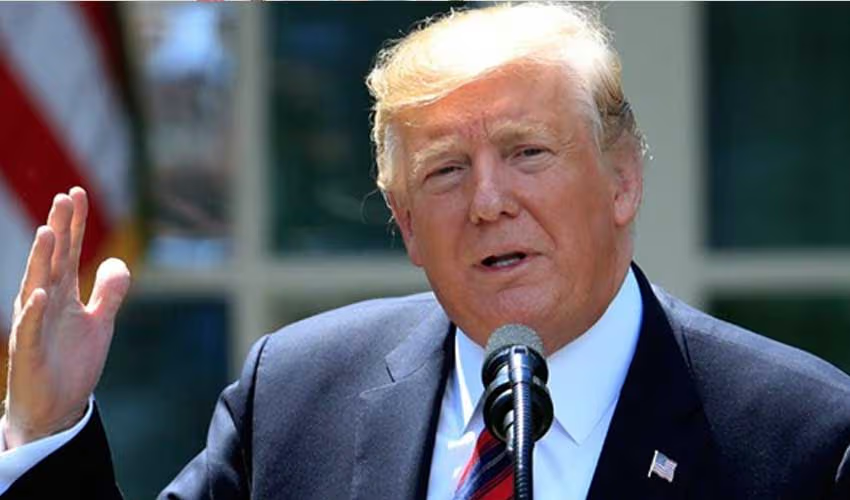
President Donald Trump has proposed giving every American adult a $5,000 payment if Republicans maintain control of Congress in the upcoming midterm elections.
Trump made the extraordinary pledge during the Republican Party’s first midterm convention in Dallas, placing the proposed payment at the center of a speech heavily focused on the November election.
The president described the proposed payment as a “Trump dividend,” but provided few details about how such a program would be funded or administered.
It was also unclear whether the president could legally authorize the payments without congressional action.
With roughly 270 million US adults, a $5,000 payment to each person would carry a potential price tag of approximately $1.35 trillion.
Trump Makes Midterm Election a Referendum on His Presidency
Trump used his lengthy address to highlight what he described as major achievements during his presidency.
He declared that he had completed “the greatest two years in the history of the presidency” and urged voters to keep Republicans in power.
The president warned that handing control of Congress to Democrats would put the country on a difficult path.
“We hand America’s future to the radical left Democrats,” Trump said, arguing that Republican victories would allow his administration to continue its agenda.
Trump also told supporters to treat the election as though he himself were on the ballot.
“I’m asking you to pretend that I’m on the ballot,” he said, reinforcing his central role in the Republican campaign strategy.
How Would the $5,000 Payment Work?
Trump did not explain the precise mechanism behind the proposed $5,000 dividend.
The size of the potential program immediately raises questions about its funding, eligibility requirements and congressional approval.
A nationwide payment of that scale could cost around $1.35 trillion if roughly 270 million adults qualified.
Trump’s proposal therefore represents a major financial commitment, although it remains unclear whether the plan is an established policy proposal or primarily an election campaign promise.
The administration would likely need congressional involvement for any large-scale federal spending program of this nature.
Republicans Bet on Trump Ahead of Midterms
The Dallas convention demonstrated how closely Republican electoral strategy remains tied to Trump.
Republican National Committee Chairman Joe Gruters reportedly referred to the event as “Trumpapalooza,” reflecting the president’s dominant presence throughout the gathering.
Trump is expected to campaign heavily in competitive states and congressional districts in the weeks leading up to Election Day.
The strategy carries risks for Republicans in politically competitive areas.
Some Republican lawmakers facing difficult races have sought to maintain distance from Trump, while others continue to rely on his support and the enthusiasm of his political base.
Several prominent Republicans did not attend the Dallas gathering, including lawmakers facing competitive challenges in their respective states.
At the same time, numerous candidates in closely contested House and Senate races were scheduled to appear at the convention.
Cost of Living and Iran War Remain Election Issues
The Republican gathering comes as voters continue to focus heavily on the cost of living and the ongoing war involving Iran.
Those issues received less attention from some early convention speakers than attacks on Democrats over immigration, border security and transgender participation in sports.
Trump defended US military action against Iran during his speech, saying his administration acted to prevent Tehran from obtaining a nuclear weapon.
He also predicted that oil prices would decline after what he described as a US victory in the conflict.
However, the war has remained a major source of uncertainty, with questions surrounding its duration and the status of Iran’s nuclear capabilities.
Iran has denied seeking to develop a nuclear weapon.
Trump Attacks Democrats as ‘Radical Left’
Much of the Republican convention messaging focused on portraying Democrats as far-left and dangerous.
Several speakers described Democratic politicians using terms such as “socialists” and “communists,” echoing rhetoric frequently used by Trump and other Republican leaders.
Senator Tim Scott, who leads the Republican Senate campaign effort, described Democrats as “dangerous, radical and weird.”
The strategy appears aimed at energizing the Republican base ahead of the midterms.
However, the approach also highlights the challenge facing Republicans in attracting independent and swing voters who may be more focused on economic conditions and foreign policy.
Competitive Republicans Face a Difficult Choice
The convention exposed a strategic dilemma for Republicans running in closely contested elections.
Candidates may benefit from Trump’s ability to mobilize his core supporters, but some could also face pressure from voters who remain dissatisfied with the president.
Republicans therefore have to balance loyalty to Trump with the need to broaden their appeal beyond his strongest supporters.
Democrats, meanwhile, are seeking to capitalize on concerns about inflation, the Iran conflict and Trump’s approval ratings.
The outcome could determine whether Republicans retain control of Congress or Democrats take control of at least one chamber.
Midterms Become Test of Trump’s Political Influence
With Election Day approaching, Trump is increasingly placing himself at the center of the Republican campaign.
The proposed $5,000 dividend gives voters another major policy promise to consider while the president continues to promote his economic and foreign-policy record.
Whether the proposal gains traction could depend on questions about its cost, legal authority and how the payments would be financed.
The midterm elections will ultimately provide a major test of whether Trump can translate his influence over the Republican base into victories in competitive congressional races.