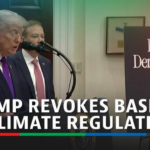


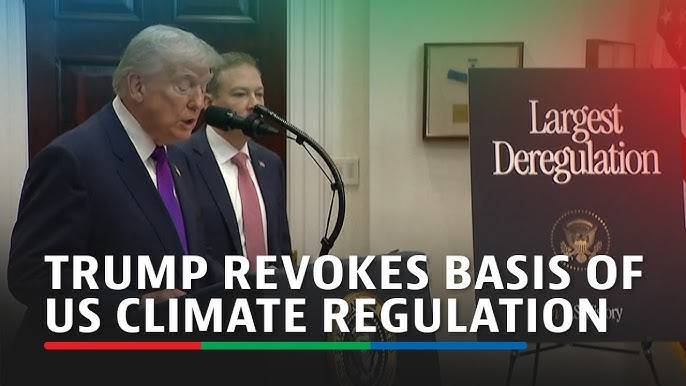
Washington, D.C. — President Donald Trump on Thursday officially revoked the Environmental Protection Agency’s landmark 2009 “endangerment finding,” a legal determination that underpinned decades of U.S. climate regulations aimed at curbing greenhouse gas emissions.
The rollback immediately eliminates federal greenhouse gas standards for automobiles and puts other major climate rules in jeopardy, including emissions limits for power plants and methane controls for oil and gas producers. The move represents the largest dismantling of U.S. climate policy under Trump to date, with legal challenges expected to follow swiftly.
Trump Calls Climate Rules a “Scam”
At a White House event, Trump dismissed the scientific basis for regulating greenhouse gases, calling the endangerment finding “a giant scam.” He framed the measure as a cost-saving effort, claiming it would generate over $1 trillion in regulatory savings and reduce new car costs by thousands of dollars.
“This determination had no basis in fact, had none whatsoever, and no basis in law,” Trump said. He added that human-caused climate change is “nothing to do with public health.”
Criticism from Democrats and Environmentalists
The rollback drew immediate condemnation. Former President Barack Obama, under whose administration the endangerment finding was established, said, “We’ll be less safe, less healthy and less able to fight climate change — all so the fossil fuel industry can make even more money.”
Manish Bapna, president of the Natural Resources Defense Council, called the move “the single biggest attack in history on the United States federal government’s efforts to tackle the climate crisis.”
Background on the Endangerment Finding
The 2009 determination declared that six greenhouse gases, including carbon dioxide and methane, threaten public health and welfare. It followed the 2007 Supreme Court ruling in Massachusetts v. EPA, which classified greenhouse gases as pollutants under the Clean Air Act. Originally applied to vehicle emissions, the finding later became the foundation for a broad range of federal climate regulations.
The Trump administration’s repeal argues that greenhouse gases are “global, indirect pollutants,” meaning regulating them domestically cannot meaningfully resolve climate change worldwide. Critics argue that this reasoning ignores decades of scientific consensus and prior Supreme Court affirmations, including a 2022 ruling.
Flawed Science and Economic Claims
The administration has relied on a government-commissioned report by climate skeptics to justify the repeal, a study widely criticized for misrepresenting data and containing major errors. Environmental advocates also say Trump’s focus on cost savings ignores the benefits of cleaner air, improved public health, and the push toward electric vehicles, potentially harming U.S. competitiveness in the global auto industry.
With this rollback, the United States faces a pivotal legal and political battle over the future of climate action, potentially reshaping greenhouse gas policy for years to come.