
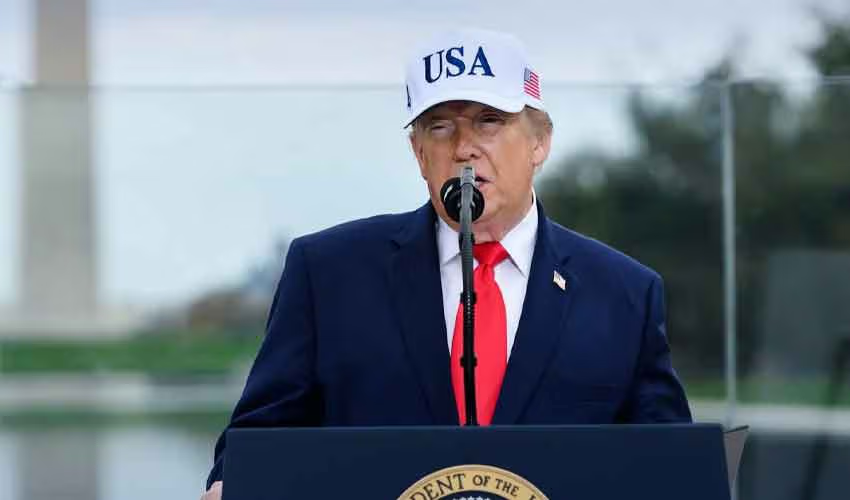
President Donald Trump says the United States is satisfied with its current pressure campaign against Iran but remains prepared for further military action as diplomatic negotiations continue over the Strait of Hormuz and Tehran’s nuclear programme.
US President Donald Trump has indicated that Washington is not planning an immediate large-scale military operation against Iran, although he warned that American forces remain ready to launch additional strikes if the situation demands it.
In an interview with the Financial Times on Tuesday, Trump said the United States was achieving its objectives in the ongoing confrontation with Tehran. His comments came after he confirmed a limited American strike on an Iranian military installation near the strategically important Strait of Hormuz.
During the six-minute telephone interview, Trump suggested that Washington was currently satisfied with the pressure being applied to Iran and saw little reason to escalate military operations immediately.
“We seem to be getting everything we want,” Trump told the newspaper.
However, he did not rule out further attacks, particularly after Israeli Prime Minister Benjamin Netanyahu reportedly suggested that military action could take place later in the week.
“I’m ready, we’re ready. We’re locked and loaded if we need to go, but there may be no reason for it,” Trump said.
The president described America’s position as a favourable one, arguing that the US blockade of Iranian ports was placing considerable economic pressure on Tehran. He also claimed that oil shipments through the Strait of Hormuz had increased compared with the period before the conflict.
Trump further attempted to distinguish the confrontation from larger historical wars, saying the United States was not engaged in a conflict comparable to World War I, World War II or the war in Ukraine.
Trump Confirms Limited Strike on Iranian Military Facility
The latest developments followed Trump’s confirmation of an American military operation against an Iranian facility on Qeshm Island, located near the Strait of Hormuz.
Speaking during an interview with Fox News, Trump said US forces had targeted an anti-aircraft installation shortly after its construction was completed.
“They built an anti-aircraft facility… As soon as it was completed, we hit it last night very nicely,” he said during the Fox & Friends programme.
The president described the operation as a minor attack rather than the beginning of a broader military campaign.
An Israeli military spokesperson told AFP that Israel had not participated in the reported strikes.
The announcement came shortly after Trump suggested that a potential agreement with Iran remained possible. His comments also coincided with the US midterm election period, when the administration’s handling of the Iran conflict and rising domestic costs had become important political issues.
Despite signalling an interest in diplomacy, Trump has continued issuing warnings to Tehran. Earlier, he suggested Washington might eventually have to use overwhelming force against Iran if negotiations failed.
He has also identified additional potential targets, including Pickaxe Mountain in central Iran, a location Washington suspects is connected to the country’s nuclear programme. Tehran has rejected allegations surrounding its nuclear activities.
Iran Warns Washington Against Renewed Military Action
Iranian officials have responded to the latest American military developments with strong warnings, insisting that the country is prepared to defend itself against another military campaign.
Mohammad Bagher Ghalibaf, Iran’s chief negotiator in discussions with Washington, said the country remained prepared for confrontation and had its forces ready to respond.
He also argued that responsibility for preventing another war now rested with the United States.
Deputy Foreign Minister Kazem Gharibabadi maintained that Iran retained the right to legitimate self-defence following the reported American strikes.
Meanwhile, Iranian President Masoud Pezeshkian has continued supporting diplomatic efforts to resolve the crisis.
Pezeshkian warned that renewed hostilities would benefit neither country and highlighted the importance of negotiations in preventing further instability.
He also indicated that Iran’s supreme leader had recently provided the government with additional authority to negotiate issues that had previously remained outside the scope of diplomatic discussions.
US and Iran Continue Discussions Over Nuclear Programme
Despite the military tensions, diplomatic communication between Washington and Tehran has continued through intermediaries.
Iranian Foreign Minister Abbas Araghchi confirmed that indirect negotiations with American officials were underway.
US Vice President JD Vance also indicated that discussions had produced some progress, although he stopped short of suggesting that a final agreement was imminent.
“We’ve certainly made some progress. We’ll see if we can make some more,” Vance told reporters.
One of the biggest obstacles remains Iran’s stockpile of enriched uranium, which Washington considers a major concern for regional and international security.
Trump referred to the material as nuclear dust and expressed dissatisfaction with the possibility that it could remain buried beneath large quantities of rock.
The issue is expected to remain central to negotiations as both governments explore potential arrangements to prevent further military escalation and address concerns surrounding Iran’s nuclear programme.
Qatar Pushes for Temporary Agreement Between Washington and Tehran
Qatar has continued playing a diplomatic role in efforts to reduce tensions between the United States and Iran.
Foreign Ministry spokesperson Majed Al Ansari said Doha remained hopeful that an interim agreement could be reached, adding that both sides were examining proposals presented through Qatari mediation.
A senior Iranian official also indicated that Tehran could consider reopening the Strait of Hormuz within two days if Washington accepted several Iranian demands.
These conditions reportedly include ending hostilities across all fronts, unfreezing Iranian financial assets, lifting oil-related sanctions and terminating the American counter-blockade of Iranian ports.
Iran has also referred to an earlier seven-day proposal aimed at restoring access to the strategic waterway.
Foreign Ministry spokesperson Esmaeil Baqaei described the possibility of implementing the proposal within two days as evidence of Tehran’s willingness to pursue a diplomatic understanding.
Strait of Hormuz Remains Critical to Global Oil Markets
The Strait of Hormuz continues to be one of the most important elements of the US-Iran confrontation because of its strategic position in international energy transportation.
The narrow waterway connects the Persian Gulf with the Gulf of Oman and serves as a major route for oil and gas shipments to international markets.
Any prolonged disruption could create uncertainty across global energy markets, potentially affecting oil prices, shipping costs and economies that depend heavily on imported energy.
Trump has argued that American pressure is weakening Iran’s economic position, while Tehran has maintained that it will not accept an agreement that ignores its security and economic demands.
With both governments continuing indirect negotiations, the possibility of a diplomatic breakthrough remains open. However, Iran’s warnings and Trump’s readiness to launch further military operations highlight the risks facing the region.
For now, Washington appears interested in maintaining its current pressure campaign rather than immediately expanding military operations, while Tehran continues demanding sanctions relief and an end to the blockade as part of any potential settlement.