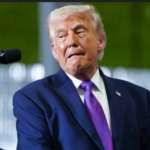

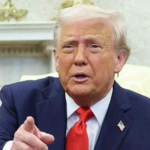
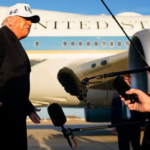
WASHINGTON — President Donald Trump unveiled a sweeping national security strategy on Friday that dramatically redefines America’s role in the world, declaring that the United States will step back from its historic role as the planet’s dominant power and instead focus on enforcing U.S. interests in the Western Hemisphere.
The long-awaited strategy document frames Trump’s “America First” worldview as a sharp break from decades of bipartisan foreign policy, which prioritized global military leadership and competition with emerging powers in Asia.
While the strategy acknowledges China as a top competitor, it downplays the long-standing U.S. ambition to maintain a robust military presence in Asia, signaling a shift in both priorities and geography.
National Security Agenda Moves Focus to Latin America
The strategy calls for a “readjustment of our global military presence” away from regions whose value to U.S. national security has “declined” and toward urgent threats “in our Hemisphere.”
The document signals that Latin America will become the central theater of U.S. engagement, with Trump promising to assert dominance over regional politics, control key resources and counter the influence of rival powers.
The strategy openly ties this approach to a revitalized version of the Monroe Doctrine, the 19th-century policy aimed at keeping Europe out of Latin America. Trump’s team describes its updated version as the “Trump Corollary,” signaling a more confrontational posture toward nations or factions seen as hostile to U.S. interests.
Hard-Line Stance on Migration and Regional Influence
Migration is described as a national security threat, with Trump vowing to battle illegal immigration “vigorously” and prevent mass movements of people from the region into the United States.
The document characterizes migrant flows as a destabilizing force that undermines U.S. institutions and burdens the economy, positioning migration enforcement as a strategic imperative rather than merely a domestic policy issue.
The strategy also touts current U.S. efforts to combat drug trafficking at sea, support governments aligned with Washington, and pressure left-leaning leaders across Latin America, including in Venezuela, where Trump has directly warned of efforts to remove President Nicolás Maduro from power.
Strategy Breaks with Pursuit of Global Dominance
One of the most striking assertions in the document is its direct rejection of America’s traditional global dominance doctrine, a position embraced by multiple administrations since the end of the Cold War.
“The United States rejects the ill-fated concept of global domination for itself,” the strategy states, adding that Washington will not “waste blood and treasure” curtailing the influence of every major geopolitical rival.
The White House positions this shift as a pragmatic recalibration meant to preserve U.S. power rather than overextend it, acknowledging that multipolar rivalry has reshaped global politics.
Harsh Words for European Union and Liberal Democratic Norms
The strategy also directed unusually sharp criticism toward European allies, accusing them of promoting “values that undermine national sovereignty,” particularly on issues such as migration.
It further suggests that the U.S. will support political movements opposed to EU-aligned policies, a stance likely to strain already tense relations with Europe’s largest powers.
Foreign policy analysts say the document represents the most unapologetic articulation yet of Trump’s ideological approach — skeptical of multilateral institutions, wary of global commitments, and intent on expanding American influence close to home.
The White House did not immediately clarify whether the strategy would result in troop withdrawals from Asia or Europe, or how quickly the military footprint could shift toward Latin America.