
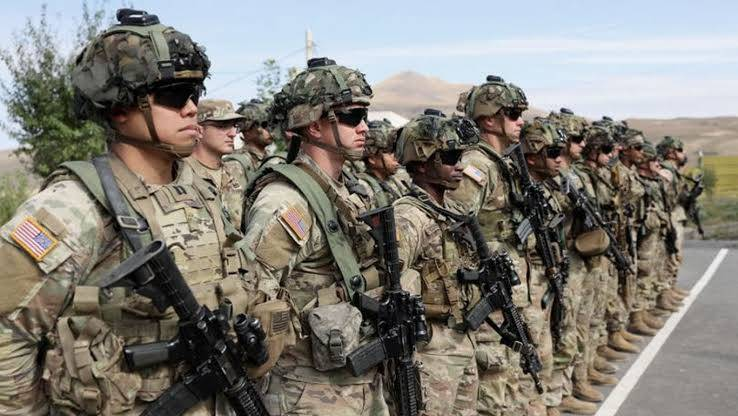
The United States has established Task Force Iron Gate to disrupt land-based supply routes into Iran, expanding its economic and military pressure campaign as an explosive-laden drone attack on a major gas facility in Iraq’s Kurdistan region disrupts electricity supplies.
The United States has launched a new operation aimed at restricting the movement of weapons, military equipment and sanctioned materials into Iran, adding another layer to Washington’s ongoing pressure campaign against Tehran.
President Donald Trump announced the development on Sunday, confirming that Task Force Iron Gate was operational and working alongside the US naval blockade of Iranian ports.
In a post on his Truth Social platform, Trump said the initiative would significantly restrict the movement of goods into and out of Iran.
“Task Force Iron Gate is in full force and effect in the Islamic Republic of Iran. Coupled with history’s greatest Naval Blockade, very little gets into, or out of, Iran!” the president wrote.
The announcement followed a statement from US Central Command (CENTCOM) on Saturday confirming the formation of a 20-member team tasked with expanding restrictions beyond maritime routes.
The new initiative reflects Washington’s intention to target Iran’s land-based supply networks, which American officials say are used to transport weapons, restricted technologies and other materials.
What Is Task Force Iron Gate?
According to CENTCOM, Task Force Iron Gate brings together 20 civilian and military personnel based in Florida to coordinate efforts with different US government agencies.
The operation is designed to monitor and disrupt the movement of advanced weapons systems, dual-use technologies, sanctioned materials and illegal financial resources across Iran’s land borders and the Caspian Sea.
CENTCOM chief Admiral Brad Cooper said the initiative would further restrict Tehran’s ability to finance armed groups, rebuild weapons manufacturing facilities and replenish its military capabilities.
The task force is intended to complement the existing naval blockade, which Washington has used as part of its broader economic pressure campaign against Iran.
US officials have claimed that the maritime restrictions have already prevented Iran from exporting more than $25 billion worth of crude oil.
By extending its efforts to land transportation networks, Washington is seeking to limit alternative supply channels that could allow Tehran to maintain trade and military procurement activities despite restrictions on its ports.
Iran Rejects US Economic Blockade Strategy
Iran’s Islamic Revolutionary Guard Corps (IRGC) has rejected Washington’s latest initiative, describing the proposed restrictions as another unsuccessful attempt to weaken the country’s economy.
IRGC spokesperson Hossein Mohebi said the United States would not achieve its objective of forcing Iran into economic collapse.
According to comments carried by the Fars news agency, Mohebi argued that Washington’s blockade strategy would fail to prevent Iran from maintaining communication and commercial connections with neighbouring countries.
He also dismissed the possibility that American restrictions could completely isolate the Islamic Republic from regional partners.
The disagreement comes after Washington announced an intensified economic pressure campaign in August, describing its approach as an effort to economically suffocate Tehran.
The measures were introduced following Iran’s restrictions on maritime traffic through the Strait of Hormuz, a strategic waterway that plays a major role in international oil transportation.
Iranian forces have repeatedly targeted vessels attempting to pass through the strait without authorisation, creating concerns about shipping security and global energy supplies.
Explosive-Laden Drone Hits Major Gas Facility in Iraq
Meanwhile, a separate security incident in Iraq’s autonomous Kurdistan region has raised further concerns about the wider regional situation.
An explosive-laden drone struck the Khor Mor gas complex on Sunday, disrupting supplies to power plants across the region.
Local Kurdish natural resources and electricity authorities confirmed that the facility came under attack at approximately 11pm local time.
A Kurdish security source told AFP that an explosive-laden drone had hit the site.
The authorities did not immediately identify those responsible for the incident.
Khor Mor is one of the most important natural gas facilities in Iraq’s Kurdistan region. The complex supplies gas to most of the area’s power stations and plays a significant role in electricity generation.
The facility is owned by Dana Gas, an energy company based in the United Arab Emirates.
Following the attack, regional electricity spokesperson Omed Ahmed confirmed that gas supplies from the complex had been halted.
Authorities said emergency measures were being taken to minimise disruptions to the electricity network and reduce the impact on residents and essential services.
Khor Mor Gas Field Has Faced Repeated Attacks
The latest incident is not the first security threat faced by the Khor Mor complex.
The facility has experienced several attacks in recent years, reflecting the continuing security challenges facing Iraq’s energy infrastructure.
The Kurdistan region has also been targeted by rocket and drone attacks against oilfields and other strategic facilities.
Local authorities have previously blamed Iran-backed armed groups operating inside Iraq for some of these incidents.
During the wider Middle East conflict, the region experienced additional attacks attributed to Iran or allied Iraqi armed factions.
However, no group had immediately claimed responsibility for Sunday’s strike on the Khor Mor facility.
The repeated attacks have raised concerns about the vulnerability of energy infrastructure and the potential consequences for regional electricity production.
Iraq Faces Pressure Over Iran-Backed Armed Groups
The latest attack comes as Iraq faces continued pressure from Washington to bring armed factions operating outside direct government control under state authority.
The United States has repeatedly called on Baghdad to disarm Iran-backed groups, arguing that their activities threaten regional security and American interests.
Iraqi Prime Minister Ali al-Zaidi, who took office this year with US backing, has pledged to ensure that armed factions surrender their weapons to the Iraqi state.
Implementing that commitment could prove challenging given the political and security influence of armed groups operating within the country.
The Khor Mor attack adds another complication to Iraq’s efforts to protect its energy infrastructure while managing relationships with regional powers.
With Washington expanding restrictions on Iran’s supply networks and security incidents continuing across Iraq, the latest developments highlight how the wider Middle East conflict is affecting regional trade, energy supplies and national security.