





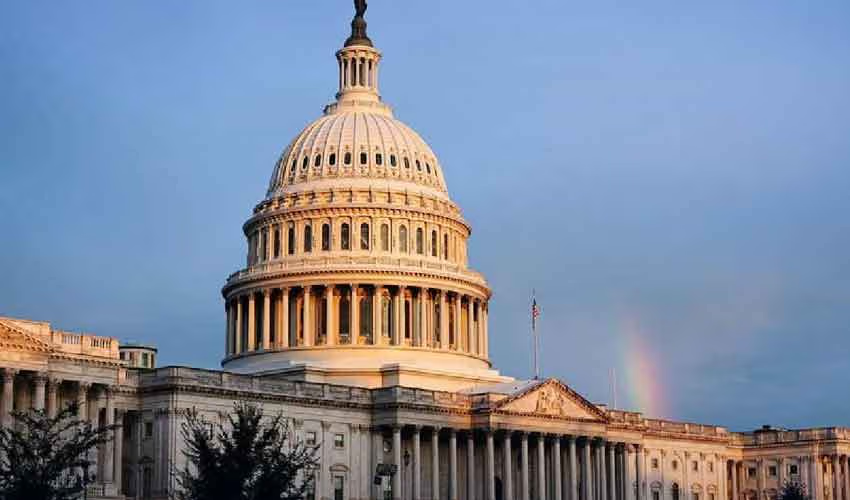
The US House of Representatives has voted for a third time to restrict President Donald Trump’s ability to continue military operations against Iran without additional congressional approval.
The war powers resolution passed 220-204 on Tuesday, September 15, with all Democrats and seven Republicans supporting the measure. It now faces an uncertain path in the Senate, where previous efforts to limit the president’s authority have not resulted in an enacted restriction.
The vote came as the financial cost of the conflict continued to draw attention in Washington. A new Congressional Budget Office analysis estimated that the war had cost the US Department of Defense more than $38 billion through August 1 and could require another $2 billion to $3 billion per month depending on the intensity of the fighting.
Third House Vote Since Iran War Began
The latest resolution, sponsored by Democratic Rep. Seth Moulton of Massachusetts, seeks to invoke Congress’s war powers and require the withdrawal of US forces from hostilities with Iran.
The House previously approved similar measures in June and July.
This time, seven Republicans joined Democrats in supporting the resolution: Thomas Massie of Kentucky, Brian Fitzpatrick of Pennsylvania, Warren Davidson of Ohio, Tom Barrett of Michigan, Nancy Mace of South Carolina, Mariannette Miller-Meeks of Iowa and Zach Nunn of Iowa.
The increased Republican support comes as lawmakers prepare to return to their districts ahead of the November midterm elections.
Moulton Says Congress Must Assert Its Authority
Moulton has argued that the conflict has continued far longer than the administration initially indicated and that Congress should have a direct role in decisions involving prolonged military action.
The Massachusetts Democrat, who served as a Marine during the Iraq War, has repeatedly questioned the legal and constitutional basis for continuing the campaign without congressional authorization.
The resolution reflects a broader dispute over the balance of military powers between the White House and Congress.
Supporters say lawmakers should exercise their constitutional authority over war and military spending, while administration supporters argue that the president retains significant authority as commander in chief.
Iran War Costs Reach More Than $38 Billion
The House vote came shortly after the CBO released its analysis of the conflict’s financial impact.
The nonpartisan budget office estimated that the Department of Defense had incurred more than $38 billion in costs related to the war as of August 1.
The CBO also estimated that continued military operations could cost between $2 billion and $3 billion each month, depending on how the conflict develops.
The agency said the economic effects extend beyond direct military spending.
Disruptions to oil and natural gas shipments through key maritime routes have contributed to higher energy prices and inflation. The CBO estimated that the conflict could leave inflation about 0.5 percentage points higher than otherwise expected during 2027.
Republicans Defend Trump’s Iran Strategy
Republicans who opposed the resolution argued that Iran remains a security threat and that limiting US military operations could create additional risks.
House Foreign Affairs Committee Chairman Brian Mast questioned what military capabilities Democrats wanted removed from the region.
Republican lawmakers have also argued that Trump is seeking to bring the long-running confrontation with Iran to an end while maintaining enough military pressure to protect US interests.
The disagreement has left Congress divided over both the administration’s military strategy and the extent of presidential authority during an extended conflict.
Strait of Hormuz Adds Economic Pressure
The conflict has also affected global energy markets because of disruptions involving the Strait of Hormuz.
The waterway is a major route for international oil and gas shipments, meaning prolonged instability can affect fuel prices far beyond the Middle East.
US lawmakers have increasingly connected the conflict’s military costs with its impact on American households.
Higher gasoline prices and broader inflation have become important issues as the November elections approach.
Trump Says War Will End
Trump has continued to defend his approach to Iran while saying that the conflict will eventually come to an end.
The president initially indicated that the fighting would last only several weeks. The conflict has instead continued for nearly seven months since February 28, according to current reporting.
Trump has also discussed the possibility of the war entering a different phase following the November elections.
At the same time, Republicans have been considering additional funding for military operations, while lawmakers remain divided over the scale and duration of US involvement.
Previous War Powers Efforts Have Stalled
The latest House action follows two earlier votes during the summer.
The House approved previous Iran war powers measures in June and July, but neither resulted in a binding restriction on the administration.
The Senate also briefly advanced a similar resolution before senators reversed course following Trump’s intervention.
That history means the latest House vote faces significant procedural and political hurdles before it could become law.
War Powers Act at Center of Dispute
The dispute is rooted in the constitutional division of military authority.
Congress has the constitutional power to declare war and control federal spending, while the president serves as commander in chief and has authority to direct military operations.
The War Powers Act of 1973 was designed to establish limits on prolonged US military engagements without congressional authorization.
The law generally provides a 60-day period for military action after certain circumstances trigger its provisions, followed by a potential 30-day withdrawal period.
Supporters of the House resolution argue that the continued Iran campaign raises questions about those limits.
The administration and its allies have disputed the interpretation and application of congressional efforts to restrict the president’s military authority.
Vote Comes Before Midterm Campaigns
Tuesday’s vote could be the final major House action specifically focused on the Iran war before lawmakers leave Washington for the campaign period.
With the November midterm elections approaching, the conflict has become increasingly connected to debates over national security, military spending, energy prices and inflation.
The CBO’s latest assessment has added another dimension to that debate by putting a multibillion-dollar figure on the direct cost of the conflict while warning that monthly expenses could continue to rise.
For now, the House has once again sent a message seeking greater congressional control over US military operations against Iran, while the measure’s next stage depends on the Senate.