
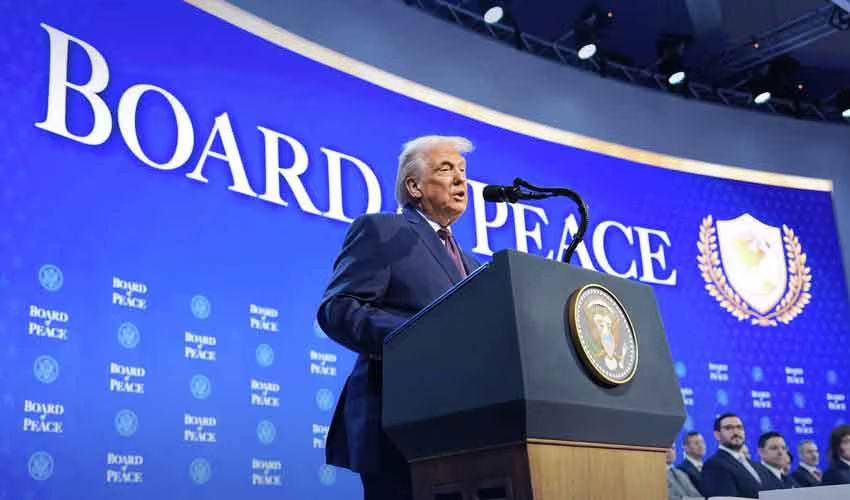
President Donald Trump’s Board of Peace is preparing to present a $2.45 billion, six-month recovery program for Gaza featuring 66 projects aimed at rebuilding homes, restoring critical infrastructure, improving healthcare and supporting economic recovery.
The proposed plan is intended to address some of the most immediate needs in Gaza following the devastating war while establishing the groundwork for longer-term Palestinian administration and reconstruction.
The six-month blueprint was developed over approximately a year by dozens of officials and experts working with the 28-member Board of Peace and a Palestinian technocratic government.
According to the proposal, Gaza’s physical damage is estimated at approximately $35.2 billion, while the cost of comprehensive recovery and reconstruction could reach around $71.4 billion over the next decade.
Housing and Basic Services Among First Priorities
Temporary housing is one of the most urgent elements of the recovery program. The plan sets aside about $400 million for insulated caravans intended to help displaced Palestinians move out of tents.
The proposal also includes a pilot project financed by the United Arab Emirates in the Rafah area. The planned “Emirati Neighbourhood” would have independent utility systems and could accommodate approximately 50,000 people currently living in temporary shelters.
Infrastructure represents the largest portion of the initial six-month spending, with about $1 billion allocated to various projects.
Approximately $275 million would support the removal of rubble and unexploded ordnance, while another $50 million would be directed toward hospital rehabilitation.
The plan also includes roughly $30 million for damaged roads, along with projects to repair border crossings and restore electricity and water networks.
As part of the energy strategy, authorities propose distributing 25,000 portable solar-power kits. The blueprint also calls for permanently filling tunnels beneath locations considered important for priority reconstruction.
Security Program Could Cost $885 Million
Security is another major component of the proposal, accounting for approximately $885 million of the six-month budget.
Around $275 million is earmarked for a permanent hardened facility in Rafah that could support up to 5,000 personnel from the proposed International Stabilization Force.
Another $140 million would help recruit, train, equip and deploy a multinational security contingent. The plan also sets aside $120 million for the mobilization of Palestinian police.
Thousands of Palestinians from Gaza have reportedly been selected and vetted for the proposed police force. However, their training plans have faced obstacles after Israel prevented the recruits from traveling to Egypt for training.
The blueprint also proposes a $20 million weapons buy-back initiative, which would provide incentives for Hamas members and members of other armed groups to surrender weapons and ammunition for safe disposal.
Eventually, the Palestinian technocratic government is expected to assume responsibility for Gaza’s border crossings with Israel and Egypt, covering both commercial goods and passenger movement.
Healthcare, Education and Economic Recovery
The recovery plan extends beyond emergency shelter and physical reconstruction. About $300 million is proposed for healthcare, education and welfare programs.
The economic component includes grants designed to help restart small businesses and plans for a new Gaza investment fund.
The Board of Peace also wants to establish digital systems that could support the territory’s future administration. Proposed projects include digital identification, electronic payments, 4G connectivity and digital health and education platforms.
Officials involved in the proposal have emphasized the concept of “Palestinian ownership,” saying Gaza’s recovery should ultimately be Palestinian-led.
Political Cooperation Remains Critical
Putting the recovery plan into practice could prove more complicated than preparing the blueprint.
The proposal depends heavily on cooperation from Israel and Hamas. Israel’s government has reportedly agreed in principle to elements previously discussed but has not moved ahead with implementation.
Hamas has also indicated agreement in principle to disarm, although that commitment has yet to be fully tested.
A key dispute involves the sequencing of a ceasefire and demilitarization. Israel has reportedly resisted implementing a 14-day ceasefire before the disarmament process begins.
The Board of Peace is looking toward Israel’s October 27 elections and the formation of a new government as a potential point for progress. Political uncertainty following the election could nevertheless complicate the timeline.
Donor Funding Still Needed
The full $2.45 billion required for the six-month program has not yet been secured.
Board officials have said the entire sum does not necessarily need to be available immediately when the Palestinian technocratic government begins operations in Gaza. They expect donor governments to potentially finance individual projects once political barriers to implementation are addressed.
Representatives from 35 countries are expected at a Board of Peace briefing, including officials from the European Union and EU member states that are not part of the board.
Trump adviser and son-in-law Jared Kushner, who has played a leading role in the administration’s Gaza initiative, and White House envoy Steve Witkoff are scheduled to address the meeting.
Other expected participants include Board of Peace High Representative Nickolay Mladenov, former British Prime Minister Tony Blair, Palestinian technocratic government head Ali Shaath, International Stabilization Force Commander Gen. Jasper Jeffers, and advisers Yakir Gabay, Liran Tancman, Aryeh Lightstone and Josh Gruenbaum.