
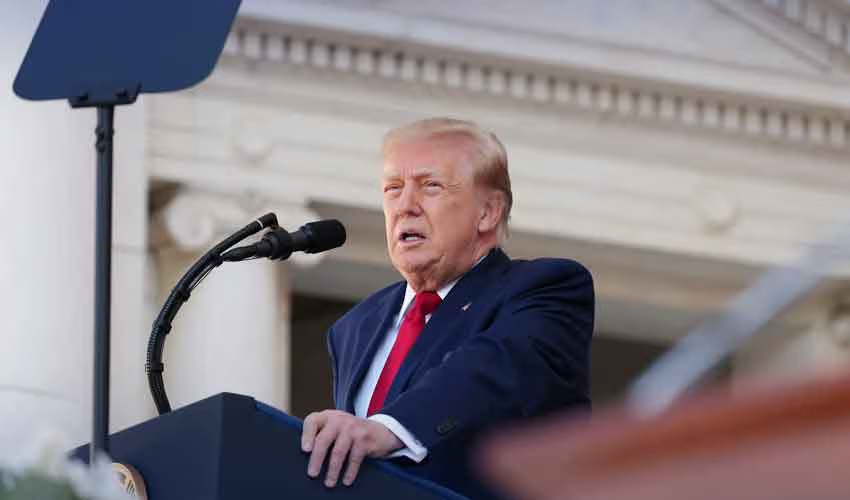
US President Donald Trump is reportedly considering holding back further military attacks against Iran unless Tehran or its regional allies carry out new provocations, as diplomatic pressure, economic sanctions and concerns over the cost of the conflict shape Washington’s next move.
President Donald Trump has privately indicated to senior advisers that he may avoid launching additional strikes against Iran if there are no fresh threats from Tehran or Yemen’s Iran-backed Houthi movement, according to people familiar with recent discussions.
The reported position suggests that the White House is weighing a more cautious approach after months of military confrontation, even as Trump continues to leave open the possibility of renewed attacks.
According to people briefed on the discussions, Trump raised the possibility of holding off on military action during meetings with national security advisers and following intelligence briefings. He has also shown consideration for regional allies who have urged Washington to avoid returning to a full-scale conflict.
Trump has repeatedly shifted between threatening further military operations and suggesting that the war could be brought to an end. His latest private comments indicate that a final decision on the future of the conflict may not yet have been made.
Speaking to sports broadcaster Stephen A. Smith on Thursday, Trump said the United States could end the conflict immediately but was taking a longer and more restrained approach at the request of countries it wanted to protect.
Saudi Arabia and Turkey Urge Trump to Avoid Fresh Attacks
Diplomatic conversations with regional leaders appear to be playing an important role in Trump’s calculations.
Over the past two weeks, the US president reportedly sought advice from Saudi Crown Prince Mohammed bin Salman and Turkish President Recep Tayyip Erdogan regarding the situation with Iran.
Both leaders encouraged Trump not to resume military attacks, according to people familiar with the conversations. However, the president did not make a commitment to follow their recommendations.
During a conversation on October 31, Trump reportedly told the Saudi crown prince that he was considering military action after the US midterm elections.
Bin Salman urged him to reconsider, arguing that economic sanctions were already putting significant pressure on Iran’s government.
Trump has also spoken with Erdogan several times since October 28. Following their November 7 conversation, Turkey’s presidency emphasized the importance of ending tensions between Washington and Tehran.
The diplomatic efforts reflect growing concern among regional governments about the potential consequences of another major military escalation.
US Sanctions Continue to Pressure Iran’s Economy
American intelligence agencies have assessed that the naval blockade and economic sanctions are creating significant difficulties for Iran’s economy, according to US officials familiar with the intelligence findings.
Washington has maintained restrictions on Iranian maritime trade while exploring additional measures to prevent weapons and other sanctioned materials from entering the country.
The US military is reportedly seeking to strengthen restrictions on supplies moving into Iran by land and through the Caspian Sea.
These measures are part of a broader strategy to weaken Tehran economically without necessarily launching another major military campaign.
The economic consequences of the conflict have also extended beyond Iran. Higher global fuel prices and disruptions to international trade have created difficulties for businesses and consumers in several countries.
In the United States, rising energy costs have become a political concern, particularly as voters question the financial consequences of continued military involvement.
US Military Keeps Options Open for Another Iran Campaign
Despite Trump’s reported willingness to delay further attacks, American military forces remain prepared for a possible escalation.
People familiar with US military planning said a third aircraft carrier was expected to move into the Middle East in the coming days to replace one of the two carriers already operating in the region.
However, officials indicated that all three carriers could remain deployed if the situation required additional military capabilities.
One option reportedly under consideration involves striking Iran’s underground nuclear facilities again. The United States has already targeted these sites, but it remains unclear whether another operation would achieve additional results.
US intelligence assessments have also suggested that renewed military strikes may not significantly change Iran’s negotiating position.
Another concern involves American weapons stockpiles. Trump has reportedly received briefings about the availability of precision-guided weapons and other military supplies following extensive use during the conflict.
Earlier reports indicated that the US had used nearly all of certain long-range precision munitions, with concerns about how quickly those supplies could be replenished.
The White House, however, maintained that the American military had sufficient ammunition and weapons to meet the president’s strategic objectives.
Israel Continues to Push for Military Action
While some regional governments are encouraging restraint, Israeli officials have reportedly continued pressing the Trump administration to consider another military campaign against Iran.
The issue highlights differences among countries involved in the regional crisis, with some prioritizing further military pressure while others fear the consequences of renewed fighting.
Trump himself has recently suggested that Washington may have achieved most of what it could through negotiations.
In a Thursday social media post, he dismissed the need for another agreement with Tehran, claiming that the United States already held significant financial and strategic advantages.
His comments have added uncertainty to the diplomatic situation, particularly as American officials continue discussing the effectiveness of sanctions and the possibility of further negotiations.
Marco Rubio Says Additional US Military Action May Not Be Necessary
Secretary of State Marco Rubio has also suggested that the United States does not currently need to launch additional military operations against Iran.
Speaking at an event organized by the Federalist Society on Friday, Rubio argued that economic pressure had significantly weakened the Iranian government.
He said the financial consequences of American sanctions and other measures were creating enough pressure to reduce the immediate need for further military action.
“And right now, frankly, the economic pain that we are inflicting on that regime is so great that there’s no need for military action because we’ve weakened them so much,” Rubio said.
The secretary of state emphasized that preventing Iran from obtaining a nuclear weapon remained the central objective of American policy.
Rubio also acknowledged that the conflict had created economic difficulties for Americans, particularly through higher fuel prices and disruptions affecting different sectors of the global economy.
Iran Conflict Creates Political Pressure for Trump
The war has become an increasingly difficult issue for the Trump administration as its economic consequences affect American households and international markets.
In a Reuters/Ipsos poll conducted shortly before the November 3 midterm elections, 55% of Americans said the war was not worth its cost.
Republicans subsequently suffered major electoral setbacks, with Democrats gaining control of Congress. Vice President JD Vance also identified the Iran conflict as a factor behind the party’s poor performance.
Trump’s reported consideration of delaying further attacks comes against this political backdrop.
With Gulf allies urging restraint, Israel continuing to advocate military pressure and American officials emphasizing economic sanctions, Washington faces several competing considerations as it determines its next steps toward Tehran.