
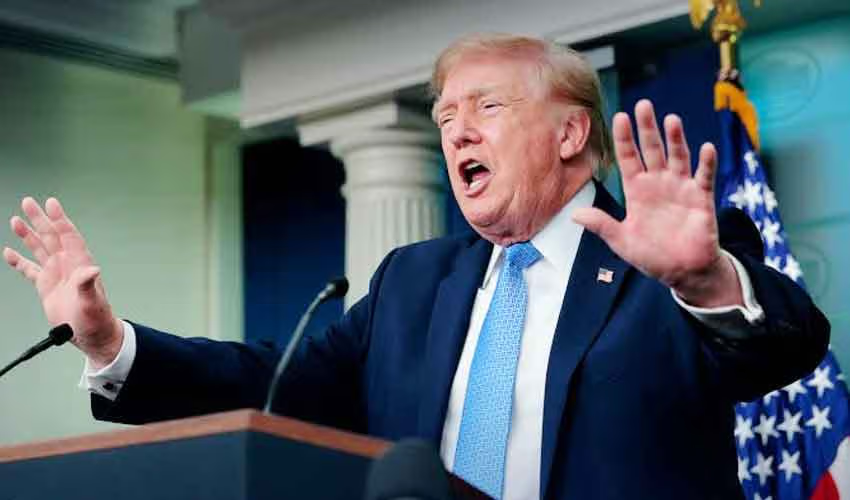
President Donald Trump has warned that the United States could launch military strikes against Iran at any moment, claiming Washington has control over the Persian Gulf and that Tehran’s military and economy are facing severe pressure.
US President Donald Trump has renewed his threats against Iran, saying he is prepared to use military force if American interests, allied countries or US vessels come under threat.
Speaking during an interview with the Salem News Channel on Thursday, Trump described the United States as being in a strong position in the ongoing conflict. He claimed Washington could achieve victory whenever he decided to take further action.
“We are currently winning a war; we could win this war at any moment — whenever I decide to win it,” Trump said.
The president also suggested that the timing of military action would depend on developments surrounding the conflict. He made clear that he would not hesitate to respond if Iran threatened American allies or ships operating in the region.
Trump’s latest remarks come as tensions between Washington and Tehran remain high, with the US maintaining economic and military pressure on Iran.
Trump Claims Iran’s Economy and Military Are Near Collapse
During the interview, Trump claimed that Iran’s economic situation had deteriorated significantly because of the US naval blockade and other pressure measures.
He cited an inflation rate of 301%, arguing that Iran’s economy had been severely damaged and that the country’s leadership was struggling to meet financial obligations, including payments to military personnel.
Trump also claimed that Iran’s navy, air force and broader military capabilities had been effectively destroyed. However, he did not provide detailed supporting evidence for these assessments during the interview.
The president was also asked whether he would continue the blockade if it took as long as 26 months to bring down Iran’s government. Trump responded that he believed the Iranian leadership was already facing collapse.
He further claimed that the United States was obtaining more oil than before the conflict and maintained that Washington had complete control over the Persian Gulf and the strategically important Strait of Hormuz.
The Strait of Hormuz is a critical international shipping route through which a substantial portion of the world’s oil and gas supplies normally passes.
Pentagon Figures Contradict Trump’s Claim About US Military Deaths
One of the most notable statements during Trump’s interview concerned American military casualties.
The president claimed that the United States had not lost a single soldier over the previous five months while discussing the progress of the conflict.
However, figures attributed to the Pentagon and dated October 29 tell a different story. According to the reported figures, 23 American service members had died in connection with the Iran war.
The reported total included 11 deaths resulting from enemy fire and 12 non-hostile fatalities. Another 865 US service members had reportedly been wounded.
These figures contradict Trump’s broad statement about the absence of American military deaths during the five-month period.
Trump Issues Warning Over Threats to US Officials
Trump also delivered a warning regarding potential Iranian attacks against senior American government officials.
During the interview, he was asked how the United States would respond if Iran killed an American official, including Treasury Secretary Scott Bessent.
The president responded with a direct threat, saying those responsible “will not exist very long any longer.”
The warning followed reports that Bessent had relocated from his residence in Washington, DC, to a US military base following alleged threats to his life linked to Iran.
The comments highlight concerns surrounding the security of senior US officials as tensions between the two countries continue.
Gulf Nations Reportedly Urge Trump to Avoid Further Attacks
In a separate interview with television personality Stephen A. Smith, Trump said several Gulf countries had asked him not to launch another major wave of attacks against Iran.
He specifically mentioned Saudi Arabia, Qatar, Kuwait, the United Arab Emirates and Bahrain.
According to Trump, leaders in these countries preferred Washington to maintain its existing approach rather than escalate the military confrontation.
He said Saudi Arabia had particularly requested that he allow the current situation to continue for some time. Trump added that he was not certain whether he agreed with the request but had maintained the existing approach.
Despite those reported requests, the president claimed the US military could destroy Iran’s energy infrastructure, bridges and manufacturing facilities within three days.
He suggested that each category of infrastructure could be eliminated within a single day if Washington decided to launch such an operation.
Trump also reiterated that the United States no longer needed a diplomatic agreement with Tehran. In a separate Truth Social post, he said the days of seeking a deal with Iran had passed.
He also instructed Vice President JD Vance, who had been involved in diplomatic efforts concerning Iran, to redirect his attention toward investigating alleged corruption in Democratic-controlled cities and states.
Trump Comments on Abdul El-Sayed’s Michigan Election Performance
The Salem News Channel interview also touched on American domestic politics, particularly the election performance of Democrat Abdul El-Sayed in Michigan.
Trump expressed surprise at the level of support El-Sayed reportedly received, questioning how the Democratic candidate had attracted substantial backing, including among Jewish voters.
“I just don’t understand it,” Trump said while discussing the reported results.
According to the Associated Press, El-Sayed defeated Republican Mike Rogers in Michigan’s Senate race, becoming the first Muslim elected to the US Senate.
Trump’s comments reflect the connection between the administration’s domestic political priorities and its foreign policy challenges.
With the US continuing pressure on Tehran and Trump keeping the possibility of further military action open, the conflict remains a major issue for Washington and countries across the Gulf region.