
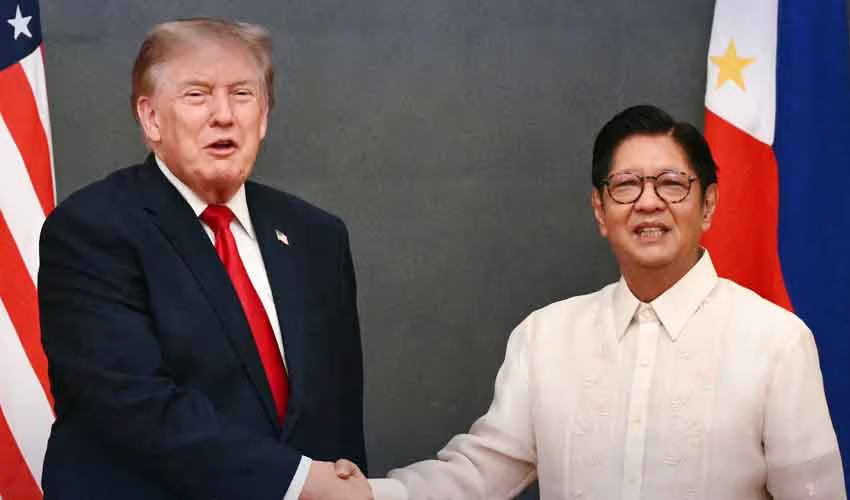
US President Donald Trump has announced what he called a major trade agreement with the Philippines during his visit to Manila, while promising stronger military cooperation with the Southeast Asian nation as tensions with China continue. However, Philippine officials say no agreement has been signed, leaving questions about the announcement and its potential economic benefits.
Trump made the announcement during a state luncheon at the Philippine presidential palace on Wednesday, alongside Philippine President Ferdinand Marcos Jr.
Describing the agreement as a significant achievement, Trump claimed it was the biggest trade deal the United States had reached so far and said it would benefit both countries.
“We’ve just consummated a very big trade deal, the biggest trade deal we’ve ever made so far, and it is a fair deal for both countries,” Trump said.
He added that the arrangement had come together quickly and expressed satisfaction with the outcome.
However, the announcement was not immediately confirmed by Manila. Neither government’s official schedule had included trade negotiations, and Philippine authorities had not released details of a completed agreement.
Philippines Says No Trade Agreement Has Been Signed
Questions emerged over the status of the deal after Philippine Ambassador to the United States Jose Manuel Romualdez addressed Trump’s announcement.
Romualdez said Washington had presented Manila with opportunities to diversify its food supplies and energy requirements. However, when asked whether an agreement had been formally signed, he confirmed that no deal had been signed.
The absence of official documentation or confirmation from the Philippine government has created uncertainty about what Trump was referring to and whether the two countries had reached a preliminary understanding rather than a finalized trade agreement.
Philippine President Ferdinand Marcos Jr’s office also did not immediately provide a detailed response to the announcement.
The situation highlights the importance of distinguishing between a political announcement and a formally concluded international trade agreement.
Trump Promises Stronger US Military Cooperation With Manila
Beyond trade, Trump used his meeting with Marcos to emphasize the importance of the longstanding US-Philippines defence relationship.
The American president pledged to expand military cooperation, describing the Philippines as an important partner in maintaining security across the Pacific region.
“We’re also expanding our defense cooperation, which has always been a key pillar of security for this part of the world,” Trump said.
He also highlighted increased American military financing for Manila and promoted US-made defence equipment.
Trump said Washington was prepared to provide both defensive and offensive weapons, arguing that American manufacturers were increasing production to meet international demand.
His comments come as the Philippines seeks stronger security assurances from Washington amid continuing maritime disputes with China.
South China Sea Dispute Remains a Major Concern
The South China Sea remains one of the most sensitive issues in relations between Manila and Beijing.
The Philippines has repeatedly raised concerns about Chinese activities in disputed waters and has sought clearer commitments from the United States under their Mutual Defence Treaty.
The agreement requires both countries to support each other in responding to certain armed attacks, including attacks on their armed forces, public vessels and aircraft in the Pacific.
Marcos was expected to seek stronger assurances from Trump during their discussions.
However, when asked about tensions in the South China Sea, the US president responded that he was not concerned.
“I’m not concerned at all,” Trump told reporters.
His response came as other Indo-Pacific countries closely monitor Washington’s long-term commitment to regional security, particularly as China continues to play an important economic and strategic role across Asia.
Trump Discusses Regional Security During Quad Meeting
Before his engagements in the Philippines, Trump participated in discussions with leaders from the Quad, an Indo-Pacific strategic partnership involving the United States, Japan, India and Australia.
The meeting focused on several issues affecting regional security and economic cooperation, including critical minerals, maritime security and artificial intelligence.
Trump also emphasized the importance of ensuring that the development of artificial intelligence reflects the values of countries cooperating with Washington.
The discussions form part of a broader American strategy to strengthen relationships with Indo-Pacific partners as competition with China intensifies.
Trump Prepares for High-Stakes Meeting With China’s Xi Jinping
Following his visit to the Philippines, Trump is scheduled to travel to Shenzhen for discussions with Chinese President Xi Jinping on the sidelines of the Asia-Pacific Economic Cooperation summit.
Trade and technology are expected to feature prominently in the talks.
Among the major issues are China’s restrictions on rare earth exports and US controls on advanced semiconductor technology supplied to Chinese companies.
The restrictions have become a significant source of tension between Washington and Beijing, particularly because advanced chips are essential for artificial intelligence development and other high-tech industries.
Trump is also expected to be accompanied by several prominent American business executives, including Tesla and SpaceX chief Elon Musk, Mastercard CEO Michael Miebach and FedEx CEO Raj Subramaniam.
Their participation reflects the importance of commercial interests in the broader US-China relationship.
Nvidia’s Jensen Huang Controversy Adds Sensitivity to China Talks
Nvidia founder Jensen Huang is not expected to join Trump’s presidential delegation, despite his previous participation in high-profile engagements involving American and Asian leaders.
The material provided for the visit also highlights allegations involving Huang and a suspected connection to Chinese intelligence, although Huang has denied wrongdoing.
The controversy has brought additional attention to Washington’s concerns about the transfer of advanced American artificial intelligence technology to China.
Before departing Washington, Trump reportedly expressed support for Huang returning to his leadership position at Nvidia.
The issue comes at a sensitive time for US technology policy, as both countries compete for influence in the global semiconductor and artificial intelligence industries.
Trump Raises Possibility of Meeting North Korea’s Kim Jong Un
Trump has also discussed the possibility of meeting North Korean leader Kim Jong Un during his Asian tour.
The US president said he had asked Xi Jinping to help arrange a meeting, although no confirmed encounter had been announced.
“He may come. I don’t know. That’s up to President Xi,” Trump told reporters before leaving Washington.
North Korea has shown limited interest in restarting diplomatic engagement, leaving the possibility of a meeting uncertain.
A potential conversation could provide an opportunity to discuss regional security and relations between Washington and Pyongyang.
Possible Trump-Xi-Putin Meeting Draws International Attention
Another major diplomatic development mentioned in connection with Trump’s China visit is the possibility of a trilateral meeting involving Trump, Xi Jinping and Russian President Vladimir Putin.
The discussions could cover nuclear arms control, Iran and other international security issues, while the war in Ukraine may also feature in broader conversations.
However, expectations of major agreements remain limited.
Oleg Ignatov, a senior Russia analyst at the International Crisis Group, said Trump’s willingness to engage with Beijing and Moscow in this format suggested openness to a potential US-China-Russia grouping.
He described the possibility as a US-China-Russia “G3,” an arrangement that could raise concerns among traditional American allies.
Such discussions could create questions about how Washington intends to balance its relationships with major global powers while protecting the interests of its existing security partners.
Trump’s latest Asian engagements highlight the administration’s efforts to strengthen American economic and military influence across the Indo-Pacific. While the proposed Philippines trade deal remains unconfirmed by Manila, the promise of expanded defence cooperation and upcoming discussions with China and Russia place the visit at the center of several important international issues.