
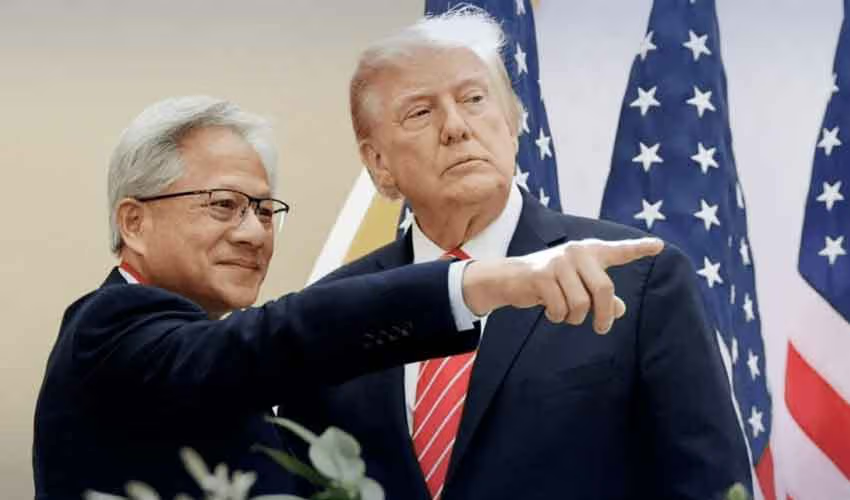
Nvidia shares fell more than 4% on Monday after US President Donald Trump revealed that the FBI was examining allegations involving company CEO Jensen Huang and a woman reportedly linked to Chinese intelligence. The development has raised questions about corporate security, US-China technology tensions, and the future of leadership at the world’s most valuable chipmaker.
Trump told reporters that he was surprised by the allegations involving Huang, one of the most influential figures in the American technology industry. According to the president, he had spoken directly with the Nvidia chief executive, who reportedly said he had no knowledge that the woman was allegedly working as a Chinese spy.
“I know the FBI is looking into it,” Trump said, while expressing confidence that Huang would be able to address the situation.
Nvidia Launches Internal Investigation as Shares Decline
The controversy intensified after Nvidia’s board initiated an internal investigation on Sunday to determine whether Huang had been targeted by a foreign intelligence operation.
The investigation has attracted significant attention because of Nvidia’s central role in the global artificial intelligence industry. Its advanced graphics processing units and AI chips are essential to major technology companies developing data centers, artificial intelligence systems, and other next-generation computing products.
Huang, 63, is widely regarded as one of the most important executives in the technology sector. His public appearances, particularly across Asian markets, have helped establish him as a prominent figure among investors, technology enthusiasts, and industry leaders.
The Nvidia CEO reportedly acknowledged to employees that he had been unfaithful to his wife, although he did not disclose specific details about the relationship.
According to LSEG data cited in the report, Huang owns approximately 3.6% of Nvidia, making him the company’s fifth-largest shareholder. He also maintains considerable influence over its operations through a relatively flat management structure in which numerous senior executives report directly to him.
Unlike some major technology companies, Nvidia does not have a dual-class share structure that would give its co-founder majority voting control.
Chinese Government Rejects Espionage Allegations
The allegations have also drawn a response from Beijing. Chinese Foreign Ministry spokesperson Guo Jiakun rejected what he described as an unfounded narrative targeting China.
He characterized the claims as groundless accusations and an attempt to damage China’s reputation.
The controversy follows reporting by The New York Times, which identified the woman as Alice Huang, a former executive at Singapore-based company Megaspeed. The newspaper reported that US authorities had investigated her and concluded that she was a Chinese intelligence asset.
Reuters reported that it could not independently determine her location to seek comment. Megaspeed also did not immediately respond to a request for comment.
The New York Times further reported that Trump had previously received information about the relationship and allegations concerning the woman’s links to the Chinese government. The president reportedly chose not to take action at that time.
Political Pressure Could Affect US-China Chip Policy
The investigation could have consequences beyond Nvidia’s corporate leadership. US lawmakers are already debating restrictions on advanced semiconductor exports to China, and the latest developments may increase pressure for tougher technology controls.
House Democratic Leader Hakeem Jeffries said Congress needed additional answers and urged lawmakers to advance an annual defense bill containing restrictions on chip sales to China.
Several lawmakers and policy advocates told Reuters that the allegations could strengthen support for legislation limiting Beijing’s access to advanced American AI technology.
Nvidia has previously benefited from major policy developments under Trump’s administration. The president has publicly praised Huang and awarded him the nation’s highest honor for scientific achievement in October.
On the same day as the award ceremony, Trump disclosed that he had purchased up to $1.6 million and sold up to $1 million worth of Nvidia shares during the summer.
Investors Watch Huang’s Position at Nvidia
Nvidia’s board has expressed confidence in Huang, but the investigation has raised questions about corporate governance and leadership succession.
Wall Street analysts generally do not expect the allegations to force Huang out of the company, although uncertainty surrounding the investigation remains a concern for investors.
Bernstein analyst Stacy Rasgon described Nvidia as an unusual company, emphasizing Huang’s central role in setting its long-term strategy and directing its business.
Meanwhile, Nvidia shareholders filed a proposed class-action lawsuit against Huang and the company on Monday. The investors allege that the company concealed information about Huang’s reported connections to a woman suspected of having links to Chinese intelligence, potentially misleading shareholders.
The allegations have not been established as proven misconduct, and the FBI investigation and Nvidia’s internal review will be important in determining what, if anything, occurred.