
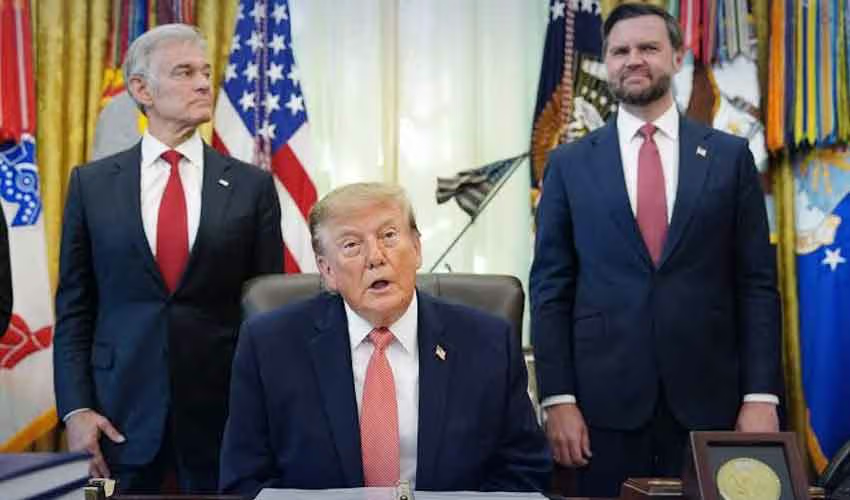
President Donald Trump has urged Vice President JD Vance to shift his attention toward investigating alleged crime and corruption in Democratic-led American cities, arguing that addressing these issues could save the federal government more money than reaching an agreement with Iran.
US President Donald Trump has called on Vice President JD Vance to dedicate his full attention to what he describes as widespread criminal activity and corruption in cities governed by Democrats. His latest remarks suggest that domestic political issues should take priority over diplomatic efforts to reach an agreement with Iran.
In a post on social media Thursday, Trump argued that addressing alleged corruption and criminal activity in major American cities could significantly improve the country’s financial position. He suggested that tackling these problems might even help balance the federal budget.
“Our Budget could be quickly BALANCED with the correction of this large scale criminal activity,” Trump wrote, adding that corruption was deeply embedded in Democratic leadership.
Trump also made a strong statement about US policy toward Iran, declaring that Washington no longer needed an agreement with Tehran. He claimed that the United States had already secured significant financial and strategic advantages, including hundreds of billions of dollars and control over the strategically important Strait.
Trump Signals Shift in Priorities for JD Vance
The president’s comments come as JD Vance faces growing attention over his involvement in efforts to address the conflict with Iran. The vice president had previously taken on responsibilities connected to diplomatic and political efforts surrounding the situation.
However, Vance appeared to distance himself from Trump’s approach to the conflict on Wednesday. His remarks followed a difficult midterm election performance for Republicans, with Democrats making significant gains.
Vance questioned whether the financial and political costs associated with the Iran war were justified. He also suggested that the conflict had contributed to Republican setbacks in the midterm elections.
The vice president further defended an earlier recommendation he had made regarding ending the war, describing that advice as sound. His position indicates growing concern within Republican circles about the domestic consequences of prolonged military involvement overseas.
Iran Conflict Becomes a Political Challenge for Republicans
The Iran conflict has emerged as an important issue for the Trump administration, particularly as the economic and political costs of the situation attract attention.
While Trump has maintained a firm position toward Tehran, Vance’s recent comments highlight potential differences in how senior Republican leaders view the conflict and its impact on the administration.
The president’s latest social media statement also raises questions about whether the administration will place greater emphasis on domestic investigations and political priorities rather than pursuing further diplomatic negotiations with Iran.
For Vance, the situation presents a complicated political challenge. He must navigate his responsibilities as vice president while addressing questions about the administration’s foreign policy decisions and their impact on Republican electoral prospects.
Trump Continues Criticism of Democratic-Run Cities
Trump has repeatedly criticized Democratic-led cities since returning to the White House in January 2025 for his second presidential term. His administration has frequently challenged local immigration policies and raised allegations of corruption and poor governance in several Democratic-controlled jurisdictions.
The president’s latest demand places these issues at the center of his expectations for Vance. By calling for the vice president to focus entirely on alleged domestic wrongdoing, Trump is signaling that investigations into crime and corruption could become a more prominent part of the administration’s political agenda.
The comments also come at a sensitive moment for Republicans as party leaders assess their midterm election performance and consider how foreign policy decisions may influence public opinion ahead of the next presidential election cycle.