
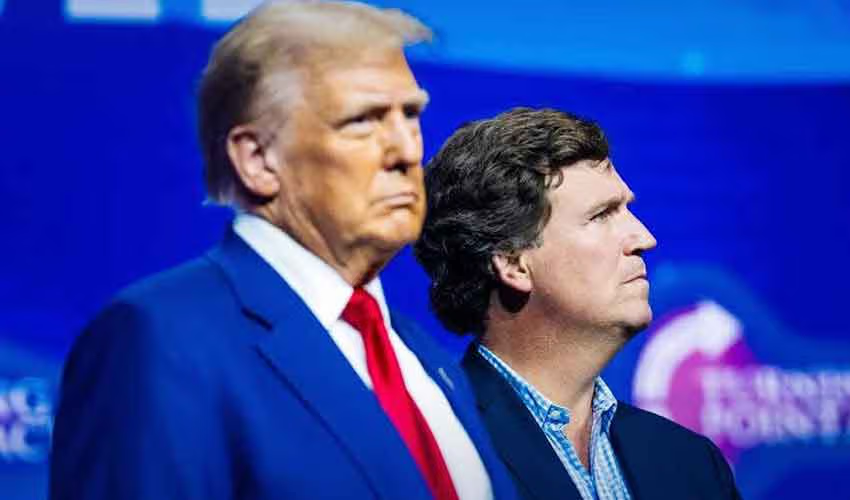
American political commentator Tucker Carlson has raised concerns about the possibility of a US nuclear strike against Iran, alleging that Israeli Prime Minister Benjamin Netanyahu is urging President Donald Trump to target an underground Iranian facility known as Pickaxe Mountain.
In a lengthy post on X, Carlson claimed that the Trump administration could make a decision about further military action by November 7. However, his allegations about a potential nuclear attack have not been independently verified, and no official announcement has confirmed that such an operation is being planned.
Carlson identified Pickaxe Mountain, located in central Iran, as a possible target. He alleged that Israeli intelligence believes Tehran has resumed uranium enrichment activities at the underground complex.
According to Carlson, the facility is protected by approximately 300 feet of solid granite, making it difficult for conventional American weapons to reach the underground tunnels. He suggested that this could lead to consideration of an extreme military option.
Citing an unnamed observer, Carlson claimed Netanyahu was regularly contacting Trump about the issue, writing: “Bibi calls Trump about it every day.”
The commentator also alleged that Netanyahu was pressing senior American officials to support renewed military operations against Iran. He named Defense Secretary Pete Hegseth, US Central Command chief Admiral Brad Cooper, Secretary of State Marco Rubio and CIA Director John Ratcliffe among the officials involved in the discussions.
Carlson did not provide independent evidence to substantiate these claims.
Carlson Alleges Netanyahu Is Pressuring Washington
Carlson argued that Netanyahu’s political position was influencing his approach to the Iran conflict. He claimed the Israeli prime minister was seeking US support to strengthen his political standing and avoid possible domestic challenges.
The commentator further alleged that Netanyahu had been lobbying members of the Trump administration against a negotiated settlement with Tehran.
He also claimed that former US president Barack Obama had opposed an Iran peace agreement being discussed in Doha during a recent meeting. Carlson did not provide supporting evidence for that allegation.
His comments come amid reports of disagreements between Washington and Tel Aviv over the timing and scope of possible military action.
According to reports cited in the supplied material, Trump has been considering whether to continue diplomatic efforts or authorise another round of strikes after the November 3 US midterm elections.
Warning Over Regional and Global Economic Consequences
Carlson also warned that renewed military action could have serious consequences for countries across the Middle East and the wider global economy.
He claimed that Gulf countries were increasingly concerned about the possibility of another confrontation after months of disruption to regional security and trade.
The commentator alleged that Netanyahu secretly travelled to Abu Dhabi on September 27 to seek support from the United Arab Emirates for another attack on Iran. He claimed Emirati officials refused the request, although the alleged meeting and its details were not independently established in his post.
Carlson also pointed to the economic effects of tensions around the Strait of Hormuz, a major international route for oil and gas shipments.
He claimed that 11 of approximately 850 oil supertankers worldwide had suffered serious damage in the waterway during October. The figure was not independently verified in the supplied material.
Any prolonged disruption to shipping through the Strait of Hormuz could affect international energy supplies, insurance costs and fuel prices. Fertiliser markets could also face pressure because energy supplies are closely connected to fertiliser production and transportation.
Carlson further warned that a nuclear explosion at Pickaxe Mountain could create serious environmental risks, including radioactive contamination affecting water supplies in the Persian Gulf region. The actual consequences would depend on the weapon used, the location and environmental conditions.
Carlson Warns of Wider Nuclear Escalation
One of the most serious parts of Carlson’s post concerned the potential international consequences of a nuclear attack.
He argued that using a nuclear weapon against Iran could weaken the global barriers against nuclear warfare and encourage other governments to consider similar action.
Carlson claimed Russia had warned at least two governments that a US nuclear strike against Iran could provide Moscow with justification to use nuclear weapons against Ukraine. He also raised concerns about possible nuclear tensions involving India and Pakistan and a potential escalation on the Korean Peninsula.
These claims about private Russian warnings and possible military responses were not supported by independently verified evidence in the material provided.
Carlson also alleged that the Trump administration had quietly revised American nuclear doctrine since February to make the first use of so-called battlefield nuclear weapons easier.
No official confirmation of the alleged policy changes was provided.
The commentator warned that a nuclear exchange could lead to a much wider international conflict, describing the consequences in extremely severe terms. His statements reflect his assessment of the risks rather than an established prediction of what would happen.
Vance and Witkoff Reportedly Support Diplomatic Efforts
Carlson claimed that Vice President JD Vance and US special envoy Steve Witkoff were encouraging Trump to pursue negotiations instead of launching another military campaign.
He argued that a diplomatic settlement remained possible despite disagreements between Washington and Tehran.
According to Carlson, people familiar with Iranian decision-makers believed further conflict would not benefit either side and that reaching an agreement remained worthwhile.
He also discussed changes within Iran’s political leadership following the reported killing of Supreme Leader Ayatollah Ali Khamenei and members of his family in February.
Carlson suggested that the developments had made Iran’s decision-making process more complicated. These claims and his assessment of internal political dynamics were not independently established in the supplied material.
Trump Mentions Pickaxe Mountain as a Potential Target
Carlson’s warning followed remarks Trump reportedly made to journalists at his Mar-a-Lago estate in Florida.
The president referred to Pickaxe Mountain and suggested that the US military had plans for the location. He also said American forces could strike certain remaining Iranian nuclear facilities within minutes.
“You can look at Pickaxe Mountain. We need to take care of that. We can do that very quickly,” Trump said, according to the supplied report.
However, Trump did not announce that a nuclear attack had been authorised. The material also states that he explicitly ruled out using nuclear weapons against Iran during an October 16 interview with Newsmax.
A White House official said the administration would not discuss sensitive military plans but reiterated that Trump was keeping all options available to prevent Iran from obtaining nuclear weapons.
Secretary of State Marco Rubio has also reportedly said that no final decision had been made about resuming military strikes.
Netanyahu and Trump Discuss Possible Military Action
The latest developments followed a reported telephone conversation between Trump and Netanyahu on Saturday.
According to an Axios report citing American and Israeli sources, the two leaders discussed negotiations with Iran and the possibility of returning to military operations.
An Israeli source described the conversation as difficult, while an American source characterised it as direct.
The report said Netanyahu was pressing Trump to resume attacks after the November 3 midterm elections, while the US president preferred to allow diplomatic negotiations more time.
Trump told reporters that discussions with Iran were progressing and that he was not in a hurry to make a decision. However, he maintained that remaining nuclear facilities would need to be addressed.
Qatar Continues Mediation as Iran Denies Nuclear Activity
Diplomatic efforts have continued alongside the military discussions. Qatari mediators reportedly held meetings with Iranian officials for a third consecutive day in an attempt to restart direct negotiations between Tehran and Washington.
Iranian Foreign Minister Abbas Araghchi said his country was making efforts to support diplomacy but stressed that an agreement had not yet been reached.
He called on the other side to demonstrate sufficient willingness to pursue negotiations rather than choose further confrontation.
The United States and Israel launched attacks against Iran on February 28, according to the supplied account. Tehran responded with attacks against Israel and American-linked targets across the region. A ceasefire was subsequently reached in April.
Washington and Tehran later signed a memorandum of understanding on June 18 concerning freedom of navigation through the Strait of Hormuz. However, disagreements over security arrangements reportedly prevented its full implementation.
Iran has denied conducting nuclear activities at the Pickaxe Mountain complex and has warned Washington and Tel Aviv against further attacks.
Carlson’s allegations about an imminent nuclear strike, Netanyahu’s lobbying efforts and changes to US nuclear policy remain unverified. Neither the White House, the Pentagon nor the Israeli government has officially confirmed that a nuclear attack against Iran is being planned.