
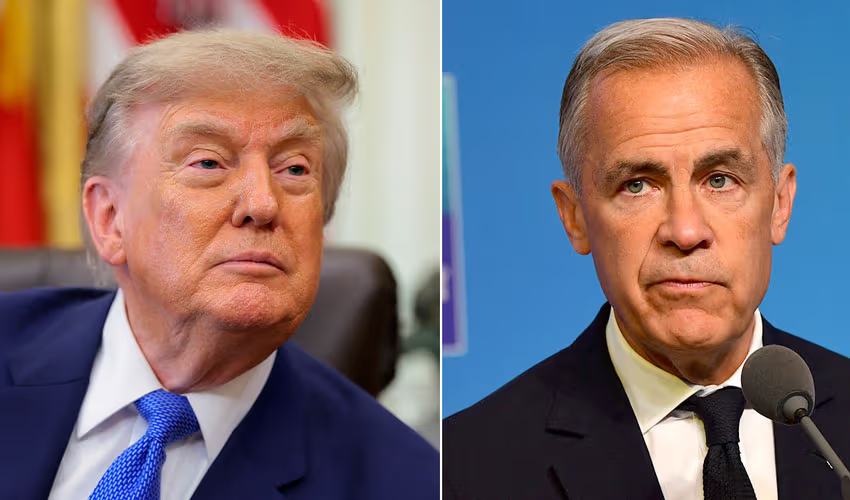
President Donald Trump has threatened to double US tariffs on automobiles and auto parts imported from Canada to 50%, delivering another major escalation in the growing trade dispute between Washington and Ottawa.
Trump announced the proposed increase in a Truth Social post on Monday, saying the new tariff rate would take effect on January 1, 2027.
The latest threat targets Canada’s automotive industry and comes shortly after the United States imposed new 50% tariffs on a range of Canadian products following the breakdown of trade negotiations.
Trump Accuses Canada of Unfair Trade Practices
Trump accused Canada of taking advantage of the United States and criticized Ottawa over tariffs on American agricultural products.
The president argued that Canadian companies could avoid US tariffs by moving production south of the border.
“Build in the U.S. and there are ZERO TARIFFS,” Trump wrote.
He also said Canada should not expect special treatment from Washington, adding that the United States could operate without relying on Canadian trade.
The comments mark another sharp escalation in Trump’s trade rhetoric toward one of America’s largest trading partners.
Canada Trade Talks Collapse
Trump’s proposed auto tariff increase follows the collapse of recent trade negotiations between the two countries.
The Trump administration had been negotiating with Canadian Prime Minister Mark Carney’s government in an effort to resolve the tariff dispute.
After the talks failed to produce an agreement, Trump ordered Canadian trade negotiators to return home.
The latest 50% tariffs on certain Canadian products subsequently took effect shortly after midnight on August 22.
Carney has vowed that Canada will respond to the American measures on a dollar-for-dollar basis, with Ottawa expected to announce additional retaliatory steps.
The escalating dispute threatens to create further uncertainty for companies that depend on cross-border supply chains.
New US Tariffs Target Canadian Products
The latest American tariffs cover slightly more than 5% of Canada’s exports to the United States.
Products affected include Canadian wine, dairy goods, hockey sticks and cement, among other items.
Carney said the tariffs would affect approximately $28 billion worth of Canadian goods.
Several important Canadian exports, however, have been excluded from the new measures.
Energy, potash, fish and critical minerals are among the products exempt from the tariffs described in the supplied material.
The affected products also do not qualify for preferential treatment under the United States-Mexico-Canada Agreement, or USMCA, which has shielded many Canadian exports from previous rounds of US tariffs.
50% Auto Tariff Could Hit North American Supply Chains
The proposed automotive tariff could have a much broader impact because the US and Canadian auto industries are deeply connected.
Vehicle manufacturers and parts suppliers operate extensive cross-border production networks, with components often moving between Canada, the United States and Mexico multiple times before a vehicle is completed.
Trump previously imposed a baseline 25% tariff on imported automobiles and auto parts, although the effective rate can differ depending on agreements and exemptions.
Increasing the Canadian auto tariff to 50% would therefore place additional pressure on manufacturers, parts suppliers and consumers.
Higher import costs could potentially be reflected in vehicle prices, while manufacturers may have to reconsider sourcing and production decisions.
Trump Also Targets Canadian Steel
Trump’s latest statement also referred to raising tariffs on Canadian steel to 50%.
However, the steel tariff is already at that level under the measures outlined in the supplied material.
The focus on steel and automobiles demonstrates the breadth of the administration’s approach toward Canadian trade.
Both sectors are closely tied to American manufacturing and are important sources of employment on both sides of the border.
Canada Prepares for Further Retaliation
Ottawa is now facing pressure to respond without causing additional damage to Canadian businesses and consumers.
Carney’s promise to match US tariffs dollar for dollar signals that Canada is prepared to retaliate if Washington proceeds with the latest measures.
Such a response could increase costs for American exporters while creating additional barriers across one of the world’s largest bilateral trading relationships.
The dispute also threatens to complicate future discussions over the USMCA, which governs much of the trade between the United States, Canada and Mexico.
With Trump’s proposed 50% auto tariff not scheduled to take effect until January 1, 2027, businesses and policymakers have another period in which to assess the economic impact and determine whether Washington and Ottawa can return to negotiations.